
The True Cost Of Cloud VoIP
How much does a cloud-based unified communications VoIP solution cost? This is a question that we get asked all the time. Read on to learn how cloud VoIP services are sold and priced, how that compares to a legacy premise based phone system, and what other hidden costs and benefits you might find when looking at UCaaS solutions.
20-User Office · 5-Year Snapshot
Cloud VoIP Total
Legacy PBX Total
Difference
Concurrent Calls: Cloud
Concurrent Calls: PBX
$26,700
$26,400
$300 over 5 years
20 Simultaneously
5 Only
Nearly identical 5-year cost — but cloud delivers 4× the calling capacity and every modern feature included.
- Pricing Models
How Each System Is Priced
Before getting to the numbers, it helps to understand how the two models are structured — because the components are fundamentally different.
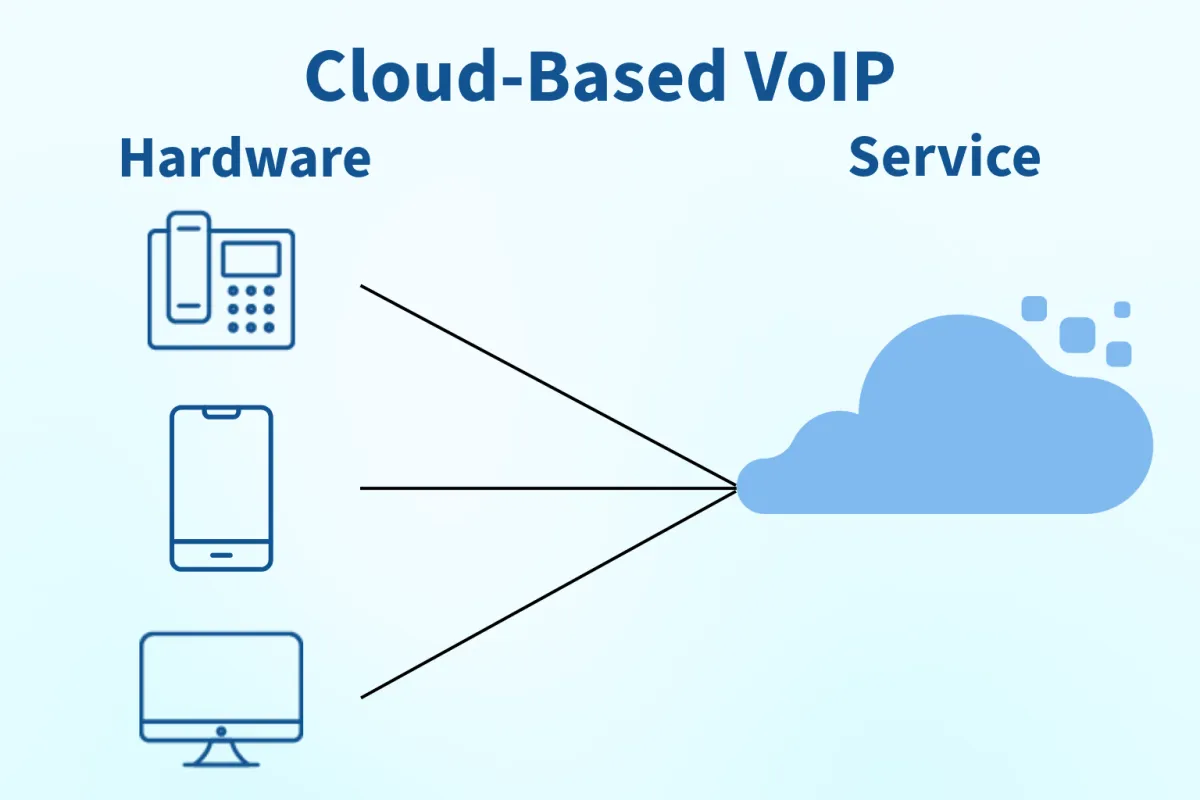
Cloud Based VoIP
Two Simple Components
The pricing model for a cloud-based VoIP communications system consists of two main components:
Hardware to connect to the cloud — Modern VoIP handsets are relatively inexpensive, and some users may not need a phone at all, opting for a headset or mobile app instead. PoE switches may be required, but even so, the upfront investment is significantly less than an on-premise PBX.
Monthly service costs — Delivered over the internet from the cloud provider. Different price tiers exist for different user needs, and the majority of companies can get by with standard or basic plans for most users.
Legacy On-Premise PBX
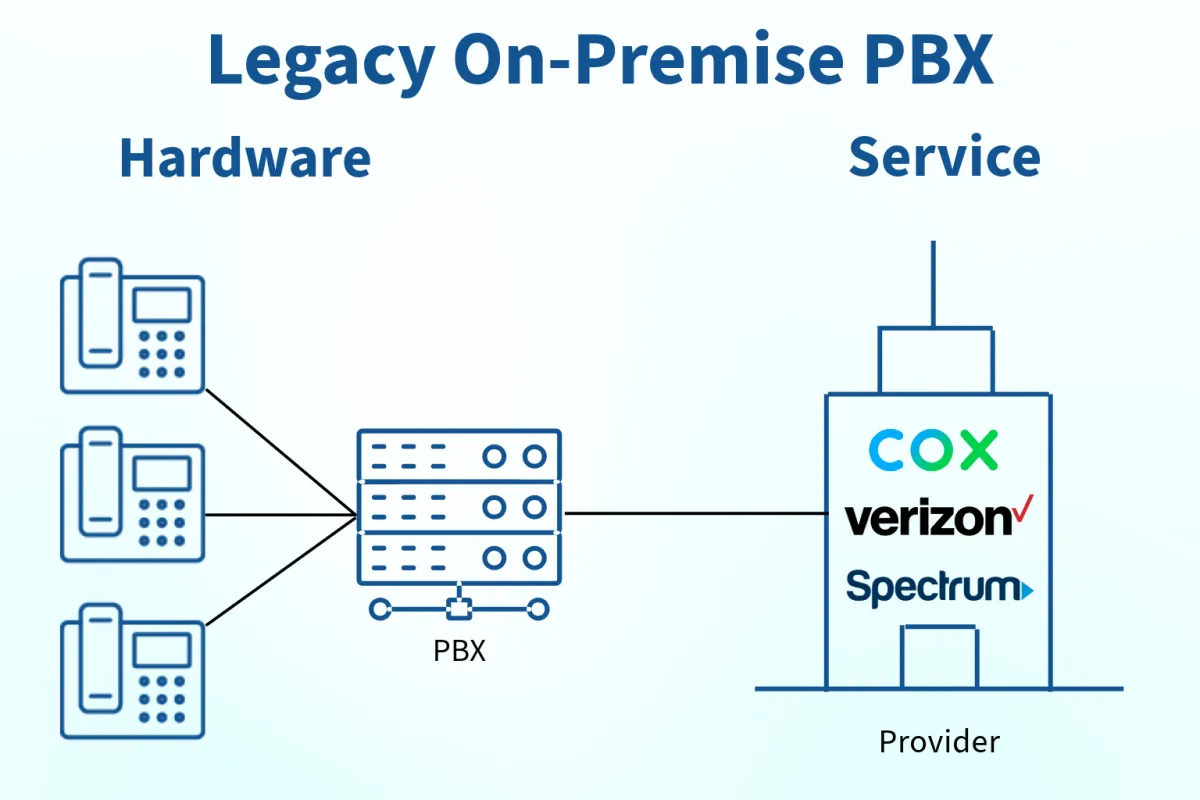
Two Heavier Components
The legacy on-premises PBX ownership model also consists of two main components:
PBX hardware — Requires a significant upfront hardware investment, making it less affordable initially. Most users need a physical handset, and PoE switches may also be required. Installation is more labor-intensive, and there are ongoing maintenance costs for software updates and programming.
Monthly phone line service — Required from your local carrier to connect your PBX to the public switched telephone network (PSTN). This can be in the form of analog lines, PRI, or SIP trunks depending on your needs, use case, and availability.
- Cost of Ownership Comparison
Real Numbers - 5 Year View
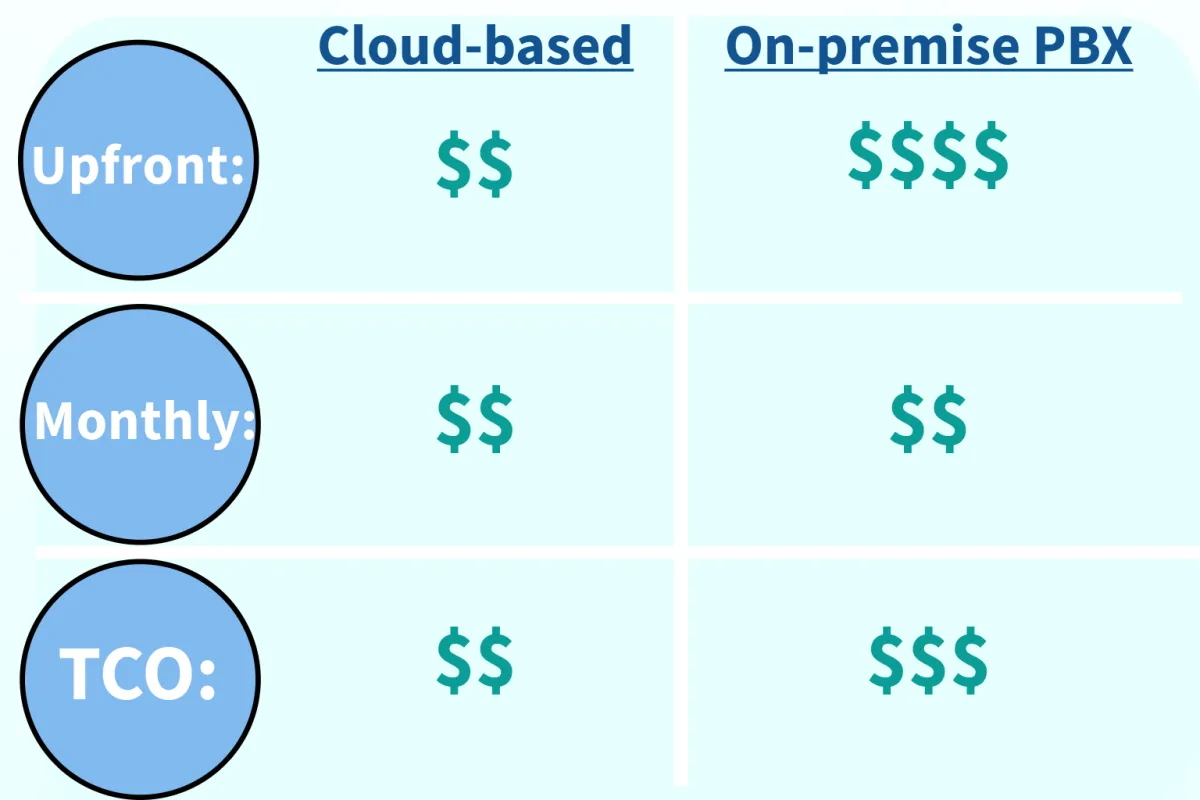
For this comparison we will use the example of a small professional office with 20 employees — a primary receptionist who answers and transfers incoming calls, and 19 staff who need their own lines. We examine total costs over the typical 5-year ownership period common to an on-premise PBX.
Cloud Based VoIP
Recommended
Hardware Cost:
20 VoIP Phones
Service Costs:
20 Standard User Seats @ $20.00 ea/month x 60 Months
Maintenance & Upkeep:
Software Upgrades, Programming, & Service
$2,700
$24,000
$0
Total Cost of Ownership Over 5 Years
$26,700
Legacy On-Premise PBX
Legacy Model
Hardware Cost:
PBX Equipment, VoIP Phones & Install
Service Costs:
5 Phone Lines @ $45.00 ea/month x 60 Months
Maintenance & Upkeep:
Software Upgrades, Programming, & Service 4x year/5 years
$10,000
$13,500
$2,900
Total Cost of Ownership Over 5 Years
$26,400
What This Means
While the five-year cost is nearly identical, what you actually get with each solution couldn't be more different. The $300 difference over five years — less than $5 per month — buys you an entirely different class of business communications tool.
✅ Cloud VoIP — What You Get
Supports 20 individual users, each with their own direct line, voicemail, SMS, and call features
Everyone can be on a call at the same time — 20 concurrent calls
Automatic updates, call transcription, mobile app, CRM integration, and remote work support at no extra cost
No maintenance bills — software updates are pushed automatically
Features keep improving throughout your subscription with no hardware changes
⚠️ Legacy PBX — What You're Limited To
Supports only 5 phone lines — your 20 employees must share, creating call bottlenecks
Only 5 concurrent calls possible unless you pay to add more lines
Advanced features like transcription, mobile app, and SMS require costly add-ons — or simply aren't available
Maintenance contracts, programming visits, and software upgrades all carry additional cost
Feature releases are limited by back-end hardware specs — processor speed, memory
Bottom line: In the example above, cloud VoIP costs less than $11/month more. If users choose to forgo desk phones and use PCs or a mobile app instead, switching to the cloud is actually less expensive. Any additional cost is easily offset by the productivity and functionality gains outlined below.
Want to see what these numbers look like for your specific business?
TCI will run a custom comparison against your current carrier bill — at no charge.
- Hidden (Intangible) Costs & Benefits
The Costs That Don't Show Up on the Invoice
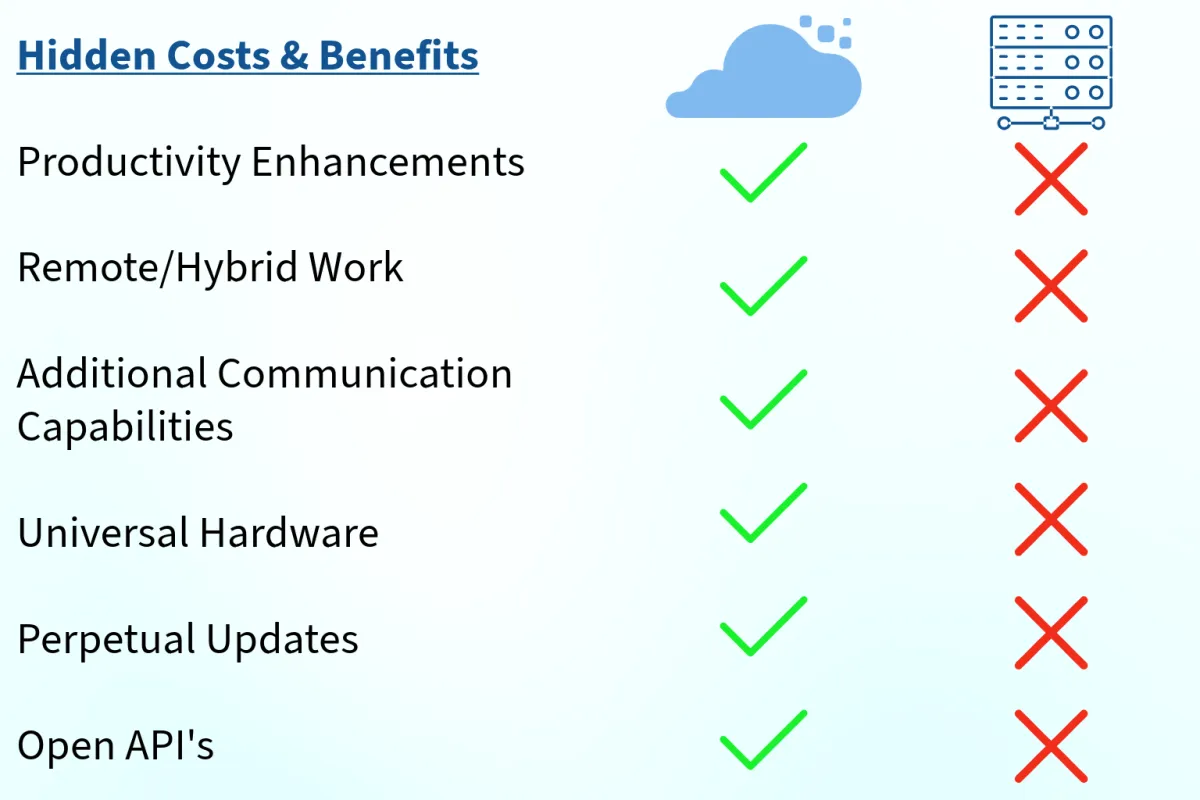
The pricing comparison above only tells part of the story. The advantages of cloud-based VoIP become even clearer when you account for the intangible benefits and hidden costs on both sides.
Cloud VoIP - Intangible Benefits
Single platform productivity
Manage all communications — voice, SMS, video, chat — from one interface, eliminating tool-switching and reducing friction.
Remote workforce deployment
Quickly deploy and easily manage remote workers, including contact center agents, without additional hardware or VPN complexity.
More ways to reach clients
Text/SMS, chat, and video give your team additional channels to communicate internally and with customers.
Universal hardware
Standard VoIP phones work with any cloud provider, reducing future switching costs significantly.
Perpetual feature updates
As new capabilities are released, they are added to your platform automatically — no action or cost required.
Open API integrations
Connect to virtually any CRM, ERP, or business software through open APIs — adding productivity and intelligence to every call.
Legacy PBX - Hidden Costs
High cost of advanced features
Call recording, SMS, mobile app access, and other modern capabilities often require expensive add-ons — or aren't available at all.
Remote workforce complexity
Deployment is cumbersome and requires additional hardware, software, and VPN configuration for each remote employee.
Limited communication methods
Voice and voicemail are the only built-in channels, pushing employees to use multiple separate platforms for chat, video, and text.
Proprietary hardware lock-in
Equipment only works within its specific ecosystem, making future upgrades expensive "forklift" replacements rather than incremental changes.
Slow feature development
Scheduled releases typically occur just twice per year, and what's possible is limited by the back-end hardware's processor speed and memory.
Proprietary API limitations
Integrations with CRM and other business software are harder to build and maintain, limiting automation and intelligence capabilities.
A Note on Network Upgrades
If you are running on a legacy digital PBX or haven't upgraded your network in a while, you may need to deploy new switching infrastructure to enable Power over Ehternet (PoE) to drive VoIP phones. This isn't a significant cost, but it will be needed in either case, whether you move to a cloud based UCaaS solution or deploy a premise based VoIP PBX. If it has been a while since you made any upgrades to your network, this switch upgrade may provide other benefits such as: faster data throughput, advanced traffic shaping and management capabilities, and PoE for security cameras and other IoT devices.
- Why You Need Cloud VoIP
The Industry Has Already Made the Move. Has Your Business?
The industry trend has been moving toward the cloud for the last 10 years — with rapid acceleration in the last 5. On-premise telephone system manufacturers have been leaving the market, moving to develop their own cloud products, partnering with existing cloud providers, or going out of business entirely.
As your local Virginia technology expert, TCI has partnered with over 50 of the top cloud providers to help you find the best cloud-based solution for your business. Our consultative approach utilizes decades of industry experience to ensure your business gets the best features at the best price. The cloud delivers better features, faster development, more advancements, and a significant ROI for most businesses.
Common Questions
VoIP Cost & Pricing FAQ
Is cloud VoIP really the same price as my current phone bill?
For most businesses, yes — or very close. The comparison above shows a difference of less than $11 per month for a 20-person office over five years. If some employees forgo desk phones in favor of softphones or mobile apps, cloud VoIP is often less expensive than a legacy system. The real question isn't price — it's what you get for that price, which is where cloud wins decisively.
Are there any setup or installation fees for cloud VoIP?
There may be a one-time provisioning or porting fee depending on the provider and the complexity of your setup. However, these are typically far less than the labor and installation costs associated with a new on-premise PBX. TCI manages this process and will give you full visibility into any one-time costs upfront — no surprises. Contact us for a custom quote.
What does "per seat" pricing mean and how does it work?
Per-seat pricing means you pay a monthly fee for each user who needs access to the phone system. Different tiers exist — basic, standard, and premium — with different feature sets at each level. Most businesses find that standard plans cover the majority of users, with premium plans reserved for power users or those who need advanced features like call recording or enhanced analytics. TCI helps you right-size the mix so you're not overpaying.
What happens to my costs if my business grows?
Adding users to a cloud VoIP system is straightforward — you simply add seats, and they're typically active within minutes. There's no hardware to procure or technician to dispatch. Contrast this with an on-premise PBX, where growth often requires additional hardware capacity purchases before you can add users. Cloud scales up (and down) with your business without capital investment.
Are there long-term contracts with cloud VoIP providers?
It varies by provider. Many offer month-to-month options, while others offer discounted rates for 1, 2, or 3-year commitments. TCI evaluates contract terms as part of our provider selection process and makes sure you understand exactly what you're committing to. We also track promotions and discounts across all 50+ providers we work with to make sure you're getting the best rate. See our migration guide for more on contracts →
Does TCI charge for its consulting and provider selection services?
No. TCI's consultative service is provided at no additional cost to you. We're compensated by the providers we work with, which means our incentive is to find you the right solution — not the most expensive one. Most of our clients end up saving money compared to going direct to a single provider, because we can compare across 50+ options and negotiate on your behalf.
Connect
Email: [email protected]
O: 757.490.7733
DCJS 11-21176
Address: 2844 Crusader Circle, Suite 450,
Virginia Beach, VA 23453


