Replace Legacy Phone Systems Before End-of-Life | VoIP & UCaaS Benefits
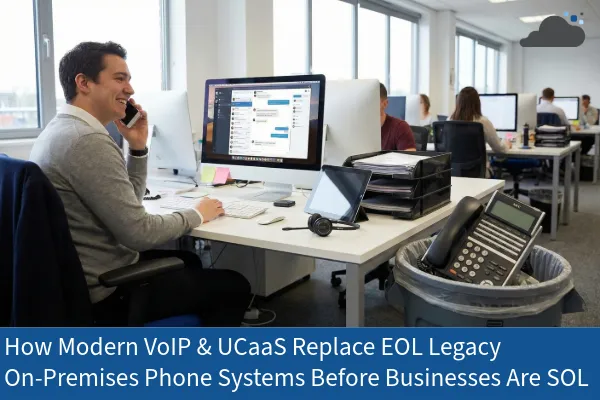
How Modern VoIP & UCaaS Replace EOL Legacy On-Premises Phone Systems Before Businesses Are SOL
As end-of-life (EOL) dates hit legacy on-premises phone systems, like the NEC SV9100, businesses across every industry are being forced to face a new reality:
Traditional phone systems are aging out, support is expiring, parts are harder to come by, and downtime is a growing risk.
And if organizations don’t transition to a modern solution before these deadlines pass, they will eventually be, as the saying goes…
SOL (Sh*t Out of Luck).
This isn’t fear marketing, it’s the outcome of hard dates, limited manufacturer support, and a communication landscape that has evolved far beyond the capabilities of old hardware-based phone systems.
The good news?
Modern VoIP (Voice over IP) and UCaaS (Unified Communications as a Service) platforms make upgrading easier, more cost-effective, and more beneficial than ever. Today’s cloud-based systems don’t just replace legacy phones systems, they modernize the entire way teams communicate.
Below, we break down what businesses need to know about legacy system EOL, why staying put is risky, and how modern VoIP and UCaaS provide powerful, future-proof solutions.
Why Legacy Phone Systems Are Risky After End-of-Life
Every on-premises phone system is supported for a limited window. Once a manufacturer issues end-of-life dates, companies must either upgrade or operate on borrowed time.
The NEC SV9100, for example, has already passed major EOL milestones:
Hardware is no longer being manufactured
Parts are harder (and more expensive) to source
Support windows are shrinking
Software patches and security updates are ending
Integrations are becoming outdated
When a system reaches full EOL, it’s not just inconvenient, it's operationally dangerous:
1. No support means no help when something breaks
If a motherboard, voicemail card, or CPU fails, that’s it. There’s no replacement part. No fix. No hotline. No patch.
One outage could take down:
inbound and outbound calls
voicemail
auto attendants
call routing
emergency notifications
And unlike cloud systems, these outages can last days (or weeks) while you scramble for a fix.
2. Parts become rare and expensive
As resellers run out of inventory, remaining parts skyrocket in price. Even refurbished hardware becomes scarce.
·Price goes up
·Quality goes down
·Risk goes up
3. Security Vulnerabilities Multiply
EOL means no more security patches or compatibility updates.
But cyber threats don’t stop.
Legacy systems can become:
unsupported
unpatched
vulnerable
This is especially risky for industries handling sensitive data (education, healthcare, government, finance, property management).
4. Your team and workflows outgrow the system
Today’s workforce is hybrid, mobile, and distributed.
Old phone systems weren’t built for:
remote workers
mobile apps
video meetings
SMS
call analytics
AI-assisted routing
integrated CRM workflows
So as businesses modernize, their phone systems become the bottleneck.
The Solution: Modern VoIP & UCaaS Are the New Standard
VoIP and UCaaS aren’t the “future” anymore, they’re the standard for business communication.
VoIP = phone calls over the internet instead of copper lines
UCaaS = phone + video + messaging + mobility + analytics + AI in one cloud platform
Both eliminate old hardware and replace it with cloud services you access on any device.
Key benefits of upgrading:
1. 99.999% Uptime & Built-In Redundancy
Unlike on-premises systems that rely on the health of a single controller, cloud systems run across distributed data centers.
So even if:
your office loses internet
your network goes down
your hardware fails
Your phone system stays live.
Employees can instantly switch to:
mobile apps
softphones
Wi-Fi
hotspots
Communications don’t stop. Ever.
2. Mobility & Remote Work Without Hardware
Modern teams aren’t chained to desk phones.
With VoIP/UCaaS, employees can work from:
laptops
smartphones
tablets
home offices
anywhere with an internet connection
All with the same extension, caller ID, voicemail, and call routing rules.
Mobility is no longer a “nice to have,” it’s essential.
3. AI-Driven Features That Legacy Systems Will Never Have
AI is now a core part of communication.
Old phone systems simply can’t compete.
Modern platforms include:
AI transcription
voice intelligence
automated call summaries
sentiment analysis
AI-powered call routing
smart queues
automated workflows
advanced call analytics
fraud/spam prevention
These tools save time, reduce workload, and improve customer experience.
4. Unified Communications in One Platform
UCaaS gives you:
phone
video meetings
team chat
SMS
fax
file sharing
call analytics
contact center tools
CRM integrations
All from one dashboard.
No more juggling:
Zoom
Microsoft Teams
Slack
standalone phone systems
One login. One platform. One monthly cost.
5. No On-Site Hardware = Lower Costs & Zero Maintenance
EOL hardware often forces expensive repairs.
But cloud systems eliminate:
servers
PBXs
voicemail modules
line cards
PRI/T1 circuits
licensing renewals
Instead, you pay a predictable monthly subscription,
Most businesses save 20-40% annually after switching.
6. Automatic Updates & Security Patches
You’ll never manually update a phone system again.
The provider handles:
updates
bug fixes
patches
new features
security improvements
Everything happens behind the scenes.
7. Modern Integrations That Expand Productivity
UCaaS systems integrate seamlessly with:
Outlook
Salesforce
HubSpot
ConnectWise
Zendesk
ServiceNow
Google Workspace
Meaning your team works faster and smarter.
The Cost of Not Upgrading: When EOL Means You’re SOL
Businesses still holding onto their legacy systems are already facing:
✔ Long wait times for parts
✔ Price increases on repairs
✔ Growing downtime risk
✔ Limited support
✔ Compatibility issues with carriers
✔ Missing modern communication tools
But the biggest risk?
A sudden system failure with no replacement options.
That’s when organizations truly become SOL.
When the last part fails and the last support rep says, “We can’t fix this,” businesses have no choice but to rush into a new system, often paying more for an emergency deployment.
Upgrading now avoids that scrambling and saves money in the long run.
How TCI Helps Businesses Upgrade Without Disruption
Upgrading doesn’t have to be stressful.
TCI handles the entire process from discovery to deployment.
Our upgrade process includes:
1. System assessment
We evaluate your current phone system and risk level.
2. Customized recommendations
VoIP or UCaaS tailored to your industry and workflows.
3. Number porting & migration planning
No downtime, no lost calls.
4. Installation, configuration & testing
Handled entirely by certified technicians.
5. Training for your team
So everyone knows exactly how to use the new system.
6. Ongoing support & monitoring
We don’t disappear after installation, we stay with you.
Industries That Benefit Most From Upgrading Now
While every business benefits from cloud communications, these industries face the highest EOL risk:
Education (K–12 & higher ed)
Healthcare
Legal
Manufacturing
Property management
Government
Hospitality
Banking & financial services
Retail
Nonprofits
Professional services
Many rely on aging NEC, Cisco, Avaya, and Toshiba systems with shrinking support.
Final Word: Don’t Wait Until You’re SOL
End-of-life means:
support ends
security updates stop
hardware disappears
downtime risk skyrockets
Modern VoIP and UCaaS aren’t just replacements, they’re upgrades that improve how your organization communicates every day.
If you wait too long, you won't have the choice to upgrade, you’ll be forced to.
And that’s how businesses end up SOL.
TCI makes the upgrade painless, affordable, and future-proof.
Ready to replace your legacy phone system with VoIP or UCaaS?
Contact TCI for a free upgrade assessment today.
FAQ Section (Optimized for Featured Snippets)
Q1: What happens when a legacy phone system reaches end-of-life?
When a phone system reaches end-of-life (EOL), manufacturers stop providing support, security patches, and replacement parts. This increases downtime risk, repair costs, and vulnerability to cyber threats.
Q2: Why should businesses replace legacy phone systems before EOL?
Upgrading before EOL prevents costly outages, eliminates security risks, and ensures your team has modern communication tools like mobility, video conferencing, and AI-powered features.
Q3: What is the difference between VoIP and UCaaS?
VoIP delivers phone calls over the internet, replacing traditional copper lines. UCaaS goes further by combining voice, video, messaging, analytics, and integrations into one cloud platform.
Q4: How much can businesses save by switching to VoIP or UCaaS?
Most organizations save 20–40% annually after replacing on-premises systems with cloud-based VoIP or UCaaS solutions, thanks to lower maintenance costs and predictable monthly pricing.
Q5: Is VoIP secure for businesses?
Yes. Modern VoIP and UCaaS platforms include encryption, automatic security patches, and fraud prevention—features legacy systems can’t provide after EOL.
