Business Calls Marked as "Spam" - Here's What You Can Do
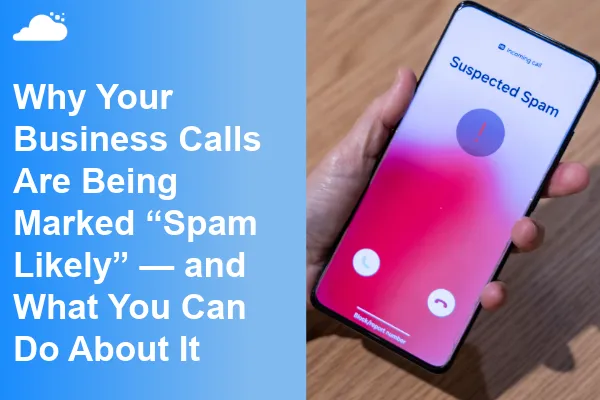
Why Your Business Calls Are Being Marked “Spam Likely” — and What You Can Do About It
Legitimate businesses with decades-old phone numbers are increasingly hitting a wall: their calls never reach customers. Here’s what’s happening, why, and the steps you can take right now.
You’ve had the same business phone number for years, maybe decades. Your team makes calls daily. And yet, more and more often, the person on the other end never picks up because their phone screen reads: Spam Likely.
This is not a fringe problem. It’s affecting businesses of every size, across every industry, using virtually every major communications platform — RingCentral, Zoom, 8x8, Intermedia, and others. Even companies with long-established numbers and clean call histories are being flagged.
To understand why this is happening and what to do about it, we need to go back to the beginning.
A Brief History of the Phone Network
Decades ago, the U.S. phone system was tightly controlled by a handful of regional carriers — the descendants of the original Bell system. Their grip on the Public Switched Telephone Network (PSTN) was absolute, and so was their control over who could place calls and how.
Over time, deregulation changed everything. Cable companies entered the phone market. Mobile carriers exploded in scale. And then came VoIP — Voice over Internet Protocol — which allowed anyone with a broadband connection to make phone calls over data networks at a fraction of the traditional cost.
This opened the door for a new generation of hosted communications providers, commonly called UCaaS (Unified Communications as a Service). Instead of routing calls through expensive incumbent carriers, they could use lower-cost underlying VoIP networks to offer competitive pricing to businesses.
“The same technology that made business calls cheaper also handed bad actors a direct line into every American’s phone.”
That same infrastructure, however, had a critical vulnerability: it allowed anyone, anywhere in the world, to place calls into the U.S. market using a U.S. phone number as their caller ID. Overseas call centers could appear to be calling from your area code. Scammers could impersonate legitimate businesses. The gates were wide open.
The Government’s Response: STIR/SHAKEN
As spam and robocall complaints reached a fever pitch, the FCC stepped in with a new framework called STIR/SHAKEN — a technical standard that forces carriers to attach a digital signature to every outbound call, certifying the legitimacy of the caller.
Under this system, every call is tagged with an attestation level:
A.
Full Attestation
The carrier has verified that the calling party is authorized to use the number. This is the gold standard.
B.
Partial Attestation
The call originated from a known customer, but the carrier cannot verify the specific number being used.
C.
Gateway Attestation
The call entered the U.S. network but cannot be traced to a verified originating source.
A call that stays entirely within one carrier’s network typically achieves full “A” attestation with no friction. The trouble begins when calls cross carrier boundaries, passing through independent networks and third-party attestation companies like Hiya, First Orion, and TNS.
The Spoofing Problem No One Can Fully Solve
Here’s where it gets complicated. Caller ID technology was never designed to be tamper-proof. With the right tools, someone in an overseas call center can broadcast your business phone number as their outbound caller ID, making it look like you’re calling when you’re not.
When those spoofed calls get flagged as spam and users report them, the negative reputation doesn’t attach to the scammer. It attaches to your number. Over time, your attestation score with services like Hiya or TNS degrades — and even though your carrier sends your calls out with a clean “A” certification, the receiving carrier’s analytics system overrides that with a spam label.
⚠ The Cruel Irony: You can do everything right — register your numbers, configure proper caller ID, maintain clean call volumes — and still be flagged because someone else is spoofing your number without your knowledge.
There’s another factor at play when businesses switch phone systems or port their numbers to a new provider. During the transition, established call history and reputation may temporarily not transfer, causing a clean number to appear “new” to carrier analytics systems. This can trigger spam labels even when the underlying number has years of legitimate use.
What You Can Actually Do About It
Step 1 — Register Your Numbers
The most important first step is registering your business numbers directly with the major attestation and analytics companies. This signals to these services that you are a legitimate business that actively monitors and protects your numbers.
For best results, create a business account using your DUNS number and register all of your numbers — your main line, auto-attendant, and direct dials — in a single account.
•Free Caller Registry (https://freecallerregistry.com/fcr/ ) — covers AT&T, T-Mobile, and Verizon. Best starting point.
•Hiya (https://www.hiya.com/ ) — used by AT&T. Create a full business account.
•First Orion (https://firstorion.com/ ) — used by T-Mobile.
•TNS / Call Guardian (https://tnsi.com ) — used by Verizon.
Step 2 — Report Directly to Individual Carriers
Beyond the attestation companies, the major carriers each have their own reporting mechanisms for removing incorrect spam labels:
•T-Mobile: https://callreporting.t-mobile.com/
•Verizon: https://voicespamfeedback.com/vsf/ — you can upload a file listing all your DIDs at once.
•AT&T: routes disputes through Hiya. Ensure your business account is fully set up there.
Step 3 — Audit Your Caller ID Configuration
Ensure your CNAM (Caller Name) record is properly configured with your VoIP or UCaaS provider. Your business name should appear clearly and accurately on outbound calls. Avoid abbreviations or acronyms that may not be widely recognized, and contact your provider to verify or update this if needed.
Step 4 — Review Your Outbound Call Patterns
Carrier spam algorithms pay close attention to call behavior. High-volume outbound bursts from a single number, large numbers of unanswered calls, or rapid sequential dialing can all trigger automated flagging — even from legitimate business operations. Work with your team to spread call volume where possible and ensure call dispositions are being logged accurately.
A Note on Paid Reputation Management Services
Several attestation companies — and some UCaaS providers — offer paid monthly services that claim to proactively manage your number’s reputation across carriers, ensuring the highest attestation level at all times.
The existence of a paid tier alongside a free registration option raises legitimate questions. There is a reasonable argument that these services have a financial incentive to allow reputation degradation in order to drive paid subscriptions. We have no proof of this, but it is worth being aware of. Our recommendation is to exhaust all free registration steps first before considering any paid service.
Managing Expectations
There is no silver bullet. Registering your numbers helps, but it does not guarantee results, and it must be completed with each service individually. If your number has been spoofed heavily, reputation recovery can take weeks. And switching phone providers does not automatically solve the problem, because the issue is tied to your numbers and how carriers evaluate them — not which platform sits behind them.
What we can tell you is that businesses who take all of the steps above — registering with attestation services, reporting to individual carriers, configuring proper CNAM, and cleaning up call patterns — consistently see improvement over time. It requires patience and ongoing attention, but it works.
Questions about your business communications setup? Our team at TCI helps organizations across the region navigate exactly these kinds of challenges.
TCI|https://tcinow.com/ |(757) 490-7733|Virginia Beach, VA
