AI Deterrence Security Cameras | TCI
AI Deterrence in Security Cameras: How Talk-Down Technology Is Changing Video Surveillance
Your Security Camera Can Do More Than Record What Happened
For years, the basic job of a security camera was simple: watch and record.
If someone entered your property after hours, your cameras captured the event. If something was stolen, you could go back through the footage. If there was an incident, you had video evidence to review.
That footage is valuable. But it still leaves one major question:
What if your security system could do something while the incident was happening?
That is where AI deterrence comes in.
AI-powered security cameras are moving video surveillance beyond passive recording. Instead of simply capturing an event and notifying someone afterward, AI can help identify activity as it happens and trigger a response designed to discourage unwanted behavior.
Some systems can even deliver a verbal warning based on what the camera sees—giving a person on the property a very different experience than they would have with a traditional security camera.
For businesses, municipalities, multifamily properties, schools, construction sites, warehouses, and other organizations managing large or vulnerable properties, that shift from reactive security to proactive deterrence can change how a security system is used.
What Is AI Deterrence?
AI deterrence is a security technology that uses artificial intelligence and video analytics to detect activity and trigger an automated response.
Rather than waiting for someone to notice an alert, the system can recognize a person or other defined activity within a monitored area and respond according to rules established for that property.
Depending on the system and configuration, that response may include:
AI-generated verbal warnings
Custom audio messages
Camera lights or floodlights
Alerts to security personnel
Remote video monitoring
Recording and event documentation
Escalation to additional security measures
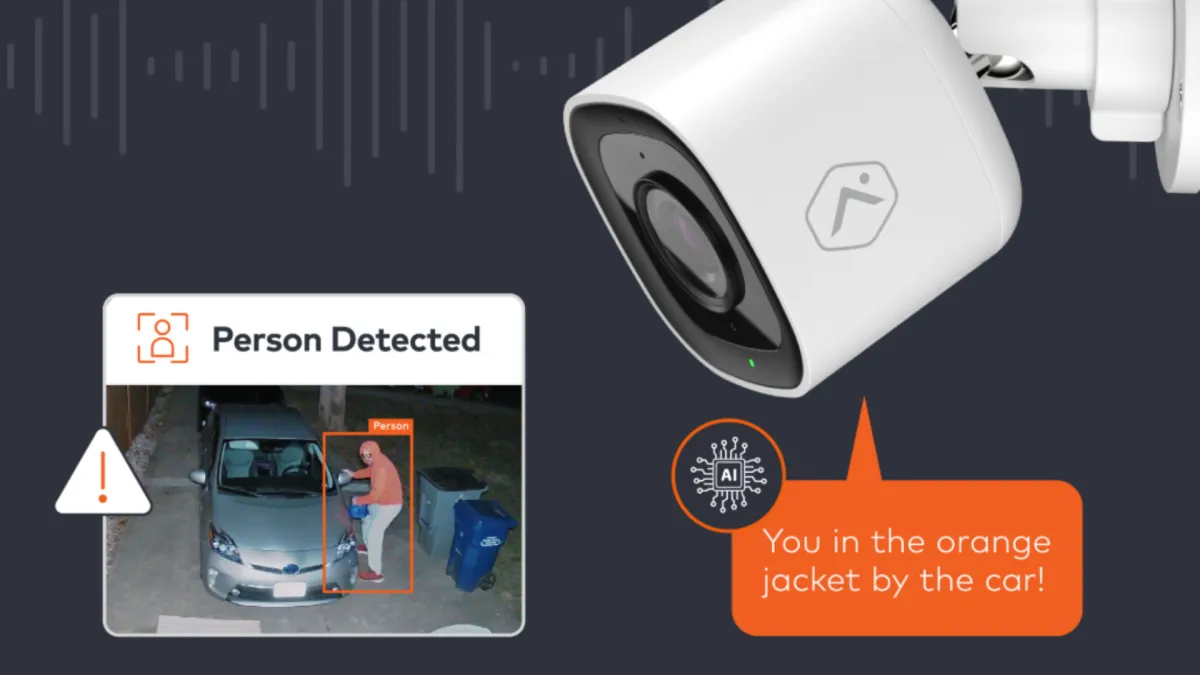
Alarm.com & Verkada’s AI Deterrence, for example, combines video analytics with AI-generated audio responses. Its technology can use visual information such as a person's clothing, clothing color, and location to create an adaptive verbal response.
The important distinction is that the camera isn't simply recording an incident anymore. It's participating in the security response.
Traditional Security Cameras vs. Proactive Video Surveillance
Traditional video surveillance remains an important part of physical security.
A camera gives your organization visibility. Recorded footage can help identify what happened, provide evidence, and support investigations.
But there is a difference between seeing an event and responding to an event.
Consider an empty commercial property after business hours.
A person enters the parking lot.
With a traditional camera system:
Person enters → Camera records → Alert is generated → Someone reviews the alert → Someone decides what to do
Depending on the system and staffing available, valuable time can pass before anyone responds.
With an AI-enabled deterrence system:
Person enters → AI analyzes the activity → System triggers a configured response → Person is warned → Security personnel can be alerted if necessary
The goal isn't to replace your security team.
It's to give your security system another layer of capability that can respond to certain situations automatically.
What Does an AI Deterrence Warning Actually Look Like?
One of the most interesting developments in AI video surveillance is the move away from generic alarms and prerecorded messages.
Instead of simply playing:
"Warning. You are on private property."
AI-enabled systems can deliver a response designed around the situation.
For example:
"You in the orange jacket by the car!"
That kind of message immediately communicates something different.
It tells the person that:
They have been detected.
The system knows where they are.
The security system is actively responding.
Alarm.com & Verkada’ s AI Deterrence can generate adaptive verbal responses based on detected activity, while its newer response modes allow customers to configure different message types, voices, and tones.
That can make the deterrent feel much more immediate than a generic alarm or prerecorded message.
Custom AI Responses Make Security More Flexible
Not every property needs the same security response.
A retail store, apartment community, construction site, municipal facility, and professional office may all have completely different reasons for using video surveillance.
That's why customization matters.
AI Deterrence capabilities allow users to create custom responses, enter their own message, and select a voice and tone for the alert.
For example, a business could configure a message such as:
"Hello. The shop is currently closed. Please return when we open at 9 AM tomorrow. Thank you."
A property manager could use a different message:
"This area is restricted. Please leave the property."
A construction site could use:
"This construction site is closed. Please leave the property immediately."
The objective isn't to make every security event sound aggressive.
Sometimes the appropriate response is simply to inform someone that they are somewhere they shouldn't be.
That's one of the advantages of configurable security technology: the response can be designed around the environment.
AI Deterrence Can Help After Hours
Many businesses don't have security personnel physically present around the clock.
That creates a common security challenge.
Your property may be active from 8 AM to 5 PM, but your cameras still need to protect it at 10 PM, 1 AM, or 4 AM.
AI deterrence & remote cameras can provide another layer of protection during those periods.
Instead of requiring an employee to continuously watch live camera feeds, configured video analytics can monitor specific areas and trigger responses when defined activity occurs.
For example, a business might configure security rules around:
Parking lots
Loading areas
Building entrances
Fenced areas
Construction sites
Storage areas
Equipment yards
Rooftops
Restricted areas
Vacant properties
The technology doesn't eliminate the need for human oversight. Rather, it helps focus attention where it is needed.
Security Cameras Don't Have to Be Passive
This is perhaps the biggest change happening in modern video surveillance.
Traditional cameras were primarily designed to document.
Today's AI security cameras can help organizations:
Detect. Analyze. Alert. Deter. Document.
That's a significant shift.
Modern video analytics can recognize people, vehicles, movement patterns, and other defined events. Depending on the platform, organizations can create rules around specific areas and activities.
TCI installs intelligent video surveillance systems that can incorporate AI-enabled cameras, access control, intrusion detection, environmental sensors, and centralized management into a broader security strategy.
That means AI deterrence shouldn't be viewed as a standalone gadget.
It's another capability within a larger physical security system.
Where AI Deterrence Can Make Sense
AI deterrence isn't necessarily appropriate for every camera or every environment.
It works best when an organization can clearly define where unexpected activity should occur and when it should occur.
For example, a parking lot that should be empty overnight is very different from a busy entrance during business hours.
Some AI deterrence systems specifically recommend using the technology in areas where unexpected activity is likely and caution against using it continuously in areas with high occupancy or heavy foot traffic.
Potential applications include:
Businesses
Protect commercial properties after hours and provide automated responses when someone enters restricted areas.
Construction Sites
Monitor equipment yards, materials, entrances, and other areas that may be vulnerable when crews aren't present.
Multifamily Properties
Help property managers monitor parking areas, restricted spaces, and other locations where unauthorized activity may occur.
Municipal Facilities
Add another layer of protection around public buildings, parking areas, equipment yards, and other facilities.
Warehouses & Industrial Properties
Monitor loading areas, exterior perimeters, and restricted areas without requiring someone to watch every camera feed continuously.
Schools & Campuses
Use carefully configured video analytics and deterrence in appropriate restricted or after-hours areas.
The key is not simply installing AI cameras everywhere.
It's determining where AI can actually solve a security problem.
AI Deterrence Isn't a Replacement for Your Security Team
It's important to put AI deterrence in the right context.
AI doesn't eliminate the need for security professionals, monitoring, access control, alarms, or emergency response.
Instead, it can become another tool within that ecosystem.
Think about it this way:
Your cameras provide visibility.
AI helps analyze what those cameras see.
Automated deterrence can respond to certain events.
Your team can receive alerts and determine what happens next.
And professional monitoring can provide another layer of response when the situation calls for it.
The goal is to build a security system where each layer supports the others.
The Real Value of AI Security Cameras Isn't Just the AI
It's easy to get caught up in the technology.
AI.
Computer vision.
Video analytics.
Automated audio.
Cloud management.
But the more important question is:
What problem are you trying to solve?
If your problem is people entering a restricted area after hours, AI deterrence may be useful.
If your problem is blind spots around a facility, adding cameras may be the priority.
If your team spends hours searching through video footage after an incident, AI-powered search and analytics may provide more value.
If you need to control who can enter a building, access control may be the missing piece.
And if you have multiple security technologies operating separately, integrating them into one platform may be the bigger opportunity.
That's why TCI approaches security as a system, rather than simply selling cameras.
Build a Security System That Can See More—and Do More
The future of video surveillance isn't just about higher-resolution cameras.
It's about making the security system more useful.
A 4MP outdoor camera with powerful lighting can provide better visibility around a property. AI-powered analytics can help identify activity. Audio deterrence can communicate with someone on-site. Alerts can bring the event to the attention of your team. And centralized management can make it easier to understand what's happening across your property.
Together, those technologies create something more valuable than a collection of cameras.
They create a proactive security strategy.
And that's where AI deterrence becomes particularly interesting.
Your camera doesn't have to sit silently in the corner waiting for something to happen.
It can see. It can recognize. It can respond.
Ready to Make Your Security Cameras Work Harder?
At TCI, we help businesses, municipalities, multifamily properties, and organizations across Virginia and North Carolina design and deploy modern physical security systems.
That can include:
AI-powered video surveillance
AI deterrence and talk-down technology
Access control
Intrusion detection
Security alarms
Environmental sensors
Cloud-based security management
Remote video monitoring
The right solution depends on your property, your risks, and what you actually need your security system to accomplish.
If your cameras are only telling you what happened after the fact, it may be time to ask what they could be doing before an incident becomes a bigger problem.
Talk to TCI about building a more proactive security system.
