AI Deterrence in Security Cameras: How Talk-Down Technology Is Changing Video Surveillance
AI Deterrence in Security Cameras: How Talk-Down Technology Is Changing Video Surveillance
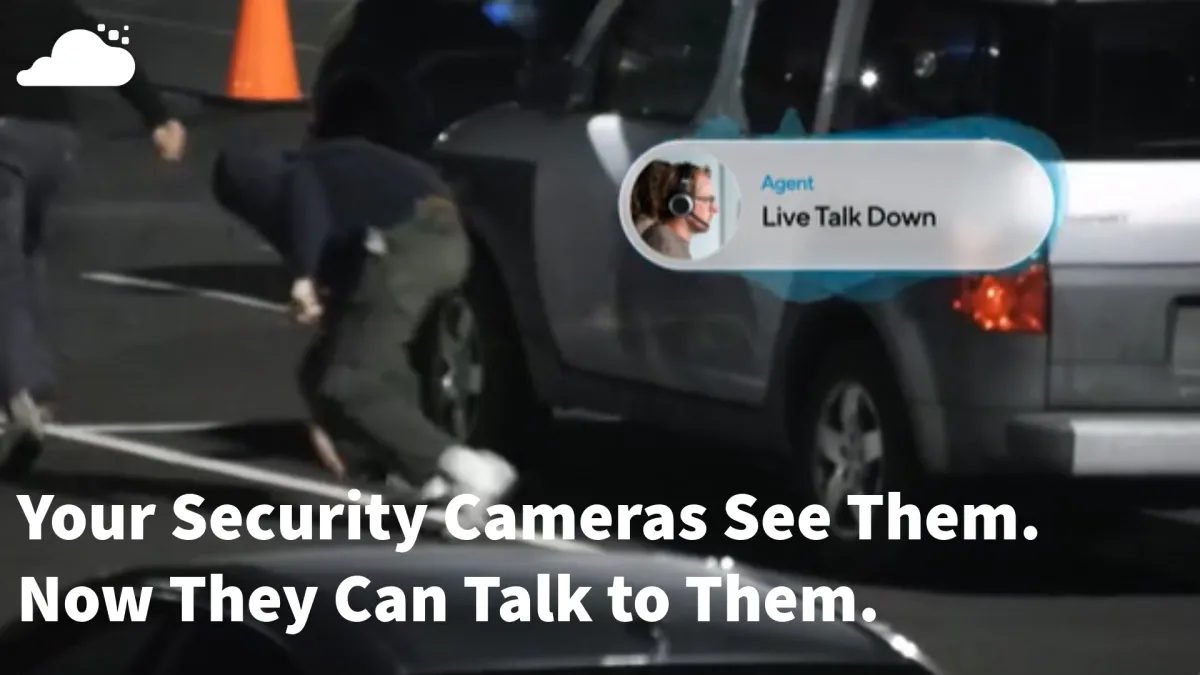
A security camera can tell you someone is on your property. But what if it could tell them to leave?
For decades, security cameras have been built to do one job exceptionally well: record. And recording matters as it documents what happened, supports investigations, and holds up in court. But there's a catch. A recording only tells you about an incident after it has already occurred. By the time someone reviews the footage, the trespasser is gone, the damage is done, or the theft has already happened.
That gap between "detect" and "respond" is exactly where AI deterrence in security cameras is changing the game. Instead of simply capturing evidence, AI-powered video surveillance systems can now identify a threat in real time and respond to it immediately — often before a human ever has to intervene.
The Problem With "Record and Review" Security
Think about someone lingering around a business after closing hours. They're not necessarily breaking in. They haven't committed a crime yet. They're just there — watching, testing doors, checking whether anyone is paying attention.
Traditional camera systems handle this scenario the same way every time:
Detect motion or activity
Record the footage
Review it later, usually after something has already gone wrong
That workflow is reactive by design. It's useful for building a case after an incident, but it does nothing to stop the incident from happening in the first place. For property owners, facility managers, and security directors, that's an expensive gap — one that shows up in shrinkage numbers, vandalism repairs, liability claims, and insurance premiums.
What Is AI Deterrence, Exactly?
AI deterrence refers to a video surveillance system's ability to combine real-time analytics with automated, on-site response — most commonly through audio talk-down capabilities. When a camera's AI engine detects a person, vehicle, or behavior pattern that matches a defined risk condition (someone in a restricted zone after hours, a vehicle lingering in a loading area, a person testing a locked door), the system doesn't just log the event. It acts.
That shifts the security workflow from:
Detect → Record → Review
to:
Detect → Respond → Deter → Alert → Record
The response is a real-time, audible warning delivered directly at the scene — often before the person has done anything they can't walk away from. In many cases, that's enough to end the encounter right there.
How AI-Powered Talk-Down Actually Works
Modern AI security cameras use advanced video analytics to interpret what's happening in a scene, not just detect that something is moving. That distinction matters. A tree branch swaying in the wind, a passing car, or a stray cat shouldn't trigger the same response as a person walking toward a locked loading dock at 2 a.m.
This is where the underlying camera intelligence comes in. Capabilities like motion grid detection let organizations define exactly which zones within a camera's field of view should trigger an alert, filtering out irrelevant movement so alerts stay meaningful. Line crossing and virtual boundary detection allow a system to recognize the moment someone enters a restricted perimeter — a fence line, a parking area, a construction zone — and treat that as an event worth responding to.
Once a triggering condition is met, the system can:
Deliver a live or pre-recorded audio warning through on-site speakers
Customize the voice, tone, and message based on the location and situation
Alert a security team or monitoring center in real time, while the deterrent message is already playing
Log the event with time-stamped video for later reference
The result is a system that doesn't wait for a human to notice an alert, review a clip, and decide what to do. It responds in the moment the risk is identified — and a human is still looped in, just after the deterrence has already started working.
Real-World Applications of AI Deterrence
The flexibility of customizable, AI-triggered responses means this technology isn't a one-size-fits-all tool. Different environments need different messages, tones, and escalation paths.
Commercial businesses can use talk-down warnings to inform someone that the property is closed and under surveillance, often enough to prevent a break-in attempt before it starts.
Construction sites, which are especially vulnerable to theft of tools, equipment, and materials during off-hours, can warn people entering the site that they're in a restricted, monitored area.
Schools and campuses can use AI deterrence to communicate that a specific zone is off-limits, supporting broader physical security and access control efforts without requiring a staff member to be physically present after hours.
Municipalities and public agencies can apply the same approach to parks, government buildings, and public infrastructure — addressing suspicious activity before it escalates into vandalism or worse.
Security teams benefit across every one of these scenarios because they receive a real-time alert while the system is already engaging the situation, rather than being the first and only line of response.
Why AI Deterrence Complements — Not Replaces — Existing Security Analytics
AI deterrence doesn't operate in isolation. It works best as part of a broader, AI-powered video surveillance ecosystem that includes capabilities such as:
AI-powered search, which lets security teams find specific footage — a red car, a person in a blue jacket — in seconds rather than hours of manual review
License Plate Recognition (LPR), which can build watchlists and issue real-time alerts when a flagged vehicle enters the property
Facial recognition, used to identify authorized personnel or persons of interest with privacy-conscious controls
An AI unified timeline, which strings together events across multiple cameras into a single chronological view, giving teams full context on how an incident unfolded
When talk-down deterrence is layered on top of these analytics, the system isn't just smarter about identifying risk — it's proactive about neutralizing it before an alarm ever needs to escalate to a phone call or a dispatched officer.
The ROI of Stopping an Incident Before It Happens
The business case for AI deterrence is straightforward. Every incident a system prevents is one that doesn't show up as a police report, an insurance claim, a repair bill, or a liability exposure. For organizations managing multiple locations, construction sites, or large campuses, that adds up quickly — both in direct costs and in the staff time spent reviewing footage and managing after-the-fact investigations.
There's also a less obvious benefit: deterrence reduces the burden on security personnel. Instead of relying on a person to monitor live feeds around the clock or respond to every motion alert, AI-powered systems handle the first line of response automatically, escalating only when human judgment is genuinely needed.
Is AI Deterrence Right for Your Property?
Not every camera, and not every environment, needs the same level of AI-driven response. The right setup depends on the property's layout, risk profile, hours of operation, and existing security infrastructure — whether that's a single storefront, a multi-site commercial portfolio, or a public facility with unique compliance requirements.
The best security incident is the one that never happens. AI deterrence gives organizations a practical way to move from simply documenting risk to actively preventing it — turning a passive recording device into an active layer of protection.
If you're evaluating whether AI deterrence and talk-down security cameras make sense for your business, construction site, school, or municipal property, TCI can help you assess your current setup and design a system built around real-time detection and response.
Schedule a demo with TCI to see AI-powered video surveillance in action.
