AI Assistants: Revolutionizing Contact Centers
AI Assistants, Customer Service Automation, Business Communication Tools
AI Assistants in the Contact Center: Meet Your New AI Digital Teammate
AI-powered contact centers are redefining how businesses and agencies communicate — not by replacing human talent, but by adding an AI Digital Teammate that handles routine work, elevates every interaction, and delivers insights leaders can act on. This new class of AI Assistants sits at the center of your communications stack, orchestrating omnichannel engagement, improving service levels, and enabling your people to focus on complex, high-value conversations.
From Call Center to AI-Powered Contact Center
Traditional call centers were built for voice — long queues, limited visibility, and manual processes. Modern operations look very different. Today’s customers expect omnichannel communication: voice, email, web chat, SMS, social media, and even video, all connected and consistent. At the same time, your employees expect flexible tools, intuitive interfaces, and automation that eliminates repetitive tasks.
AI-powered contact center platforms, like those offered by innovators such as TCI, bring these demands together into a single, cloud-based environment. At the core of this evolution is the AI Digital Teammate — an intelligent assistant that listens to every interaction, understands context, and supports both customers and agents in real time. The result is faster customer service, more productive employees, better customer experiences, and valuable business insights that were previously impossible to capture at scale.
Answering Routine Questions — Instantly and Accurately
High-volume, low-complexity interactions consume a disproportionate amount of agent time. Customers call or chat to reset passwords, check account balances, confirm appointment times, or ask basic policy questions. An AI virtual receptionist or self-service assistant can handle these routine questions autonomously — 24/7, with no hold time, and with consistent accuracy across every channel.
Using natural language understanding, the AI interprets a customer’s intent rather than forcing them through rigid IVR menus. Instead of “Press 1 for scheduling,” customers simply say, “I need to make an appointment,” and the AI responds, authenticates if needed, and fulfills the request. This is Customer Service Automation in practice — deflecting repetitive contacts, reducing queue length, and ensuring that agents are reserved for cases where human judgment and empathy are essential.
💡 Pro Tip: Start by offloading the top 10 most common questions to your AI Assistant — you will see measurable reductions in handle time and abandoned calls almost immediately.
Intelligent Routing: Getting Every Caller to the Right Resource
Beyond answering questions, AI communication platforms excel at intelligent routing. Instead of relying solely on static skills-based rules, an AI Digital Teammate analyzes the caller’s intent, language, sentiment, and historical interaction data to determine the optimal destination — the right agent, the right queue, or the right self-service workflow. This minimizes transfers, shortens time-to-resolution, and ensures complex cases are routed to your most experienced personnel.
In an omnichannel environment, this intelligent routing applies across voice, chat, email, SMS, and social channels. A customer who starts in web chat can be escalated to voice or video with full context preserved — no need to repeat information. For agencies and businesses managing sensitive or regulated interactions, this level of routing precision also supports compliance by aligning specific interaction types with appropriately trained teams.
Real-Time Summarization: Documentation Without the Drag
Post-call documentation has long been a productivity bottleneck. Agents spend valuable minutes summarizing conversations, updating CRM records, and tagging outcomes. With AI Assistants embedded in your contact center, this process becomes largely automated. As calls, chats, and messages occur, the AI transcribes, structures, and summarizes conversations in real time — capturing key details, next steps, and sentiment markers.
These summaries can be pushed directly into CRM systems, ticketing platforms, or case management tools, standardizing documentation quality across the team. Agents reclaim time, supervisors gain consistent data for analysis, and downstream teams have immediate visibility into what was discussed. This is a direct path to productivity enhancement and a more complete, auditable record of customer engagement.
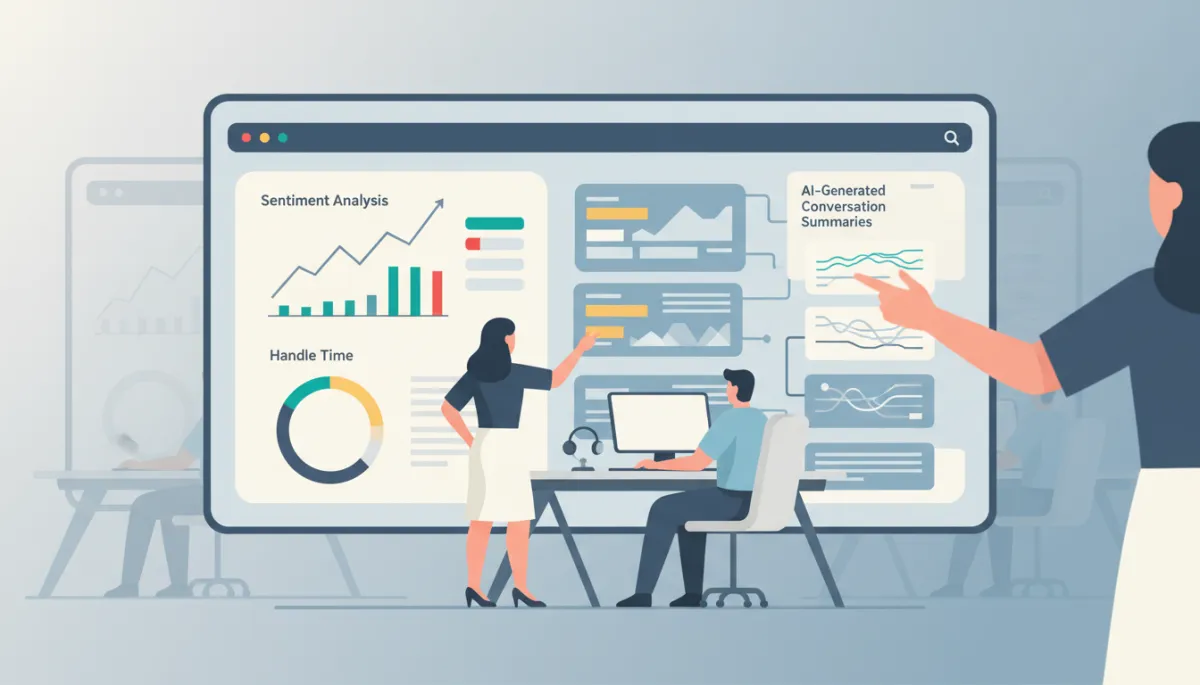
Meet Your New AI Digital Teammate — turning every interaction into structured, actionable data.
Sentiment Analysis: Understanding How Customers Actually Feel
Historically, supervisors could only sample a small percentage of interactions for quality monitoring. AI changes this dynamic entirely. Modern Sentiment Analysis engines evaluate tone, language, and conversation dynamics across every call, chat, and message — in real time, at 100% coverage. This allows your organization to detect frustration, confusion, or delight as it happens, not days or weeks later during a manual review cycle.
For businesses and agencies, this means issues can be escalated immediately, policies can be refined based on real-world reactions, and coaching can be targeted with precision. Sentiment trends become a leading indicator of customer satisfaction, service quality, and even product performance. In effect, your AI Digital Teammate becomes a continuous listening post, surfacing patterns that would otherwise remain hidden in unstructured conversation data.
Supervisor Assist and Coaching: Every Agent Performs Like Your Best Agent
Supervisors are under constant pressure — they must support agents, manage queues, enforce policy, and deliver KPIs, often across distributed or hybrid teams. AI Supervisor Assist tools change the equation by providing real-time visibility and targeted coaching signals across the entire operation. The AI monitors interactions, flags at-risk calls, and identifies coaching opportunities based on behavior, sentiment, and outcomes.
Instead of manually hunting for examples, supervisors receive prioritized alerts — for instance, when a new agent struggles with a specific scenario, or when compliance language is missed. Combined with AI Agent Assist, which surfaces suggested responses and knowledge articles during live interactions, every agent gains access to the same level of guidance your top performers rely on. Over time, this drives consistent quality, reduces performance variance, and accelerates ramp-up for new hires.
Faster Service, Higher Productivity, Better Experiences
When routine questions are automated, routing is intelligent, and documentation is handled by AI, the impact on operations is immediate. Customers experience faster customer service — shorter wait times, quicker resolutions, and fewer transfers. Agents experience more productive workflows — less time on repetitive tasks, more time on meaningful conversations, and clearer guidance during complex interactions.
The downstream effect is better customer experiences. Interactions feel more personalized because the Business Communication Tools behind them understand history, preferences, and context. Customers do not need to repeat themselves when switching channels, and they feel heard because sentiment signals are captured and acted upon. For leadership teams, this translates into measurable improvements in Net Promoter Score, customer satisfaction, and first-contact resolution — all while maintaining or reducing operational cost.
Analytics and Insights: Turning Every Interaction into Intelligence
Perhaps the most strategic benefit of AI-powered contact centers is the depth of valuable business insights they generate. Advanced analytics and reporting consolidate data from every channel — voice, email, chat, SMS, social, and video — into a unified view. Leaders can track not only volumes and handle times, but also sentiment trends, topic clusters, compliance adherence, and agent performance indicators derived from real interactions, not just after-the-fact surveys.
For businesses and agencies, this intelligence informs decisions far beyond the contact center. Product teams gain visibility into recurring pain points. Policy makers understand where customers are confused or dissatisfied. Workforce planners leverage AI-driven forecasting to align staffing with true demand, ensuring the right agents are available at the right time. In short, your AI Digital Teammate becomes a strategic sensor network — continuously capturing, analyzing, and presenting data that drives better decisions across the organization.
AI as a Team Member — Not a Replacement
A critical point for any business or agency evaluating Customer Service Automation is the role AI plays relative to human staff. The most successful deployments treat AI as a teammate, not a substitute. The AI handles volume, structure, and analysis — answering routine questions, routing intelligently, summarizing interactions, and monitoring sentiment — while human agents bring empathy, judgment, and nuanced problem-solving to the conversations that matter most.
This human–AI partnership leads to healthier work environments. Agents are less burdened by repetitive tasks and more engaged in meaningful work. Supervisors have better tools for coaching and support. Leaders gain transparency without resorting to micromanagement. In this model, AI isn’t replacing the workforce; it is becoming a valuable team member that amplifies human capability, protects against burnout, and enables your organization to deliver consistently exceptional service at scale.
Moving Forward: Building Your AI-Enhanced Contact Center
Implementing an AI-powered contact center does not require a disruptive overhaul. Many organizations start with targeted capabilities — an AI virtual receptionist to manage after-hours calls, AI Agent Assist to support a specific team, or sentiment analysis to augment existing quality programs. From there, they expand into full omnichannel orchestration, advanced analytics, and workforce optimization, guided by measurable ROI at each step.
Partners like TCI specialize in assessing current environments, mapping communication workflows, and identifying where AI Assistants and Business Communication Tools will have the greatest impact. For businesses and agencies facing rising expectations, constrained budgets, and complex regulatory requirements, this approach offers a pragmatic path forward — one where your next hire is not just a person or a platform, but an AI Digital Teammate working alongside your entire team.
As customer expectations continue to evolve, the question is no longer whether to adopt AI in the contact center — it is how quickly you can integrate it as a trusted member of your communications ecosystem. When you do, you will see the difference in faster service, higher productivity, better experiences, and insights that move your organization ahead of the curve.
