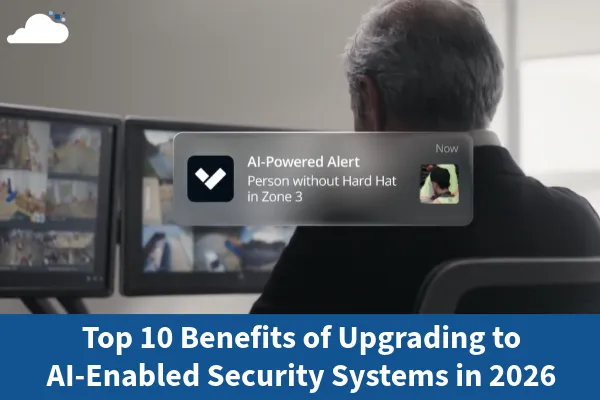
Top 10 Benefits of Upgrading to AI-Enabled Security Systems in 2026 | Modern Physical Security
Top 10 Benefits of Upgrading to an AI-Enabled Security System in 2026
Organizations across every industry are facing a new reality: traditional security systems are no longer equipped to handle modern threats. Between increasing physical security risks, data privacy concerns, staffing limitations, and the rising need for remote oversight, businesses are demanding solutions that deliver more visibility, faster response, and better intelligence.
That need has accelerated a major industry shift: the move from legacy, hardware-bound systems to AI-enabled, cloud-managed security platforms that integrate cameras, access control, alarms, intercoms, sensors, and analytics into one unified system.
As we head into 2026, this shift is no longer about “early adoption.” It’s now about staying competitive, compliant, and prepared.
In this article, we’ll explore the top benefits of upgrading to an AI-powered security system and why organizations that modernize now will be significantly ahead of those that don’t.
1. Instant Visibility and Control From Anywhere
For decades, physical security systems required staff to be on-site to review footage, manage access points, or investigate incidents. That model no longer fits today’s workforce, where:
Employees and leadership work remotely
Facilities are often distributed across multiple locations
Security teams need to respond instantly even after hours
With a cloud-managed system, everything is accessible on a secure web dashboard or mobile app, including:
Live video streams
Historical footage
Door lock/unlock controls
Alarm status
Visitor logs
Sensor readings
System health
Whether you’re at home, in another state, or visiting a different location entirely, you stay connected to your organization’s physical security in real time. That ability alone dramatically strengthens incident response, accountability, and peace of mind.
2. AI Video Analytics Reduce Investigation Time From Hours to Seconds
Traditionally, reviewing footage meant scrubbing through video manually, a tedious and costly process.
AI video analytics change that completely.
Modern platforms allow users to search footage using parameters like:
Person and vehicle detection
Clothing color

Backpack or bag presence
Vehicle type
Line crossing
Facial matching (where legally permitted)
License plate recognition
Motion detection in specific zones
Instead of reviewing five hours of hallway footage to see when someone entered a door, AI narrows results to:
“Show all instances of a person wearing blue entering this door between 3 PM and 6 PM.”
The footage appears instantly.
For organizations with limited staff, this means faster investigations, stronger documentation, and better situational awareness with a fraction of the labor.
3. Smarter Alerts Help Stop Threats Before They Become Incidents
Legacy security systems were reactive. You reviewed footage or logs after something had already gone wrong.
AI allows security systems to be proactive, generating smart alerts such as:
Forced door entry
Door held open too long
After-hours motion
Vehicle in a restricted zone
Person detected in a sensitive area

Unexpected activity patterns
Temperature, humidity, or air quality changes
Glass break or intrusion alarms
Tailgating alerts at access points
Instead of discovering an issue after the fact, your team knows immediately often within seconds.
Many platforms also let security teams trigger automated responses, such as:
Locking doors
Sounding an alarm
Activating lighting
Sending alerts to facility managers
Notifying local authorities through monitoring centers
This shift from after-the-fact review to real-time prevention is one of the most important upgrades modern organizations can make.
4. Unified Security Means No More Disconnected Systems
Most older facilities still use a mix of:
Analog camera systems
Offline NVR/DVR retention
Separate access control software
Standalone alarm systems
Manual paper visitor logs
Building sensors with no digital tracking
These systems rarely talk to each other and slows everything down.
Modern platforms unify everything into one dashboard, often connecting:
Intrusion detection

User permissions and logs
This eliminates:
Multiple vendors
Multiple software interfaces
Confusing workflows
Gaps in visibility
Delayed reporting
Lost data
Disjointed evidence trail
When an event occurs, say, a door is forced open, the system can automatically:
Record the event
Tag the associated camera footage
Log the user involved
Notify staff
Trigger a defined response
For security teams, the speed and clarity this provides is transformational.
5. Lower Operational Costs Over Time
Many organizations assume upgrades cost more, which is true upfront. But when evaluated over lifecycle cost, cloud-managed systems almost always save money, because you eliminate:
Expensive on-premises servers
Storage expansion
Manual security labor
Costly software licensing
Third-party video retrieval fees
On-site maintenance for firmware and updates
Travel between locations for troubleshooting
Cloud systems:
Update automatically
Scale without infrastructure
Require less ongoing service
Reduce downtime
Lower IT and security workload
And because everything is managed centrally, small security teams can now support multiple sites without additional staff.
That makes modern security financially strategic, not just technically superior.
6. Stronger Compliance and Digital Evidence Management
Industries like education, retail, property management, logistics, and healthcare face increasing requirements around:
Digital evidence retention
Access logs
Incident reporting
Chain-of-custody documentation
Information privacy
Audit trails
AI-enabled cloud systems make this dramatically easier. They provide:
Immutable logs
Encrypted cloud video
Tamper-proof audit trails
Automatic retention policies
Secure file sharing
User-based permission controls
If law enforcement or leadership needs evidence:
Footage can be located in seconds
Shared securely via link
Access is logged automatically
No physical drives need to exchange hands
This not only improves compliance, it reduces legal risk dramatically.
7. Cloud Systems Scale Effortlessly as You Grow
With traditional systems:
Adding a new building required new servers
Expanding camera coverage meant adding recorders
Software updates had to be rolled out manually
Cloud-managed security changes that.
New devices appear instantly in the central dashboard, even if they’re in another city.
No servers.
No new storage racks.
No reconfiguring DVRs.
No travel required.
Organizations expanding quickly—like property developers, school districts, retailers, manufacturers, and government agencies—gain enormous operational flexibility.
8. Greater Reliability and System Health Monitoring
DVR-based systems fail quietly. Storage dies. Cameras go offline. And no one knows until something happens.
Modern platforms continuously monitor:
Camera uptime
Storage capacity
Network performance
Firmware status
Device temperature
Tampering attempts
If something needs attention, administrators receive alerts before the problem affects security.
Some platforms even allow real-time remote troubleshooting, reducing costly onsite service calls.
9. Higher Standard of Safety and Visitor Experience
Businesses now face new demands:
Instant background screening
Digital badges
Temporary access credentials
Tailgating detection
Remote unlocking
Integrated video verification
Cloud-managed systems streamline all of it.
When guests arrive:
They sign in through a digital kiosk

Credentials update automatically
Cameras capture and record entry
Access and video logs sync instantly
This not only improves safety, it creates a professional first impression.
10. Future-Proofing Your Entire Organization
Security expectations will only grow in 2026 and beyond.
Technology is advancing rapidly:
AI detection is becoming more precise
Integrations between physical and cybersecurity are strengthening
More industries are moving toward remote operations
New compliance standards are emerging
Legacy hardware is aging out
Upgrading now ensures organizations won’t be forced into rushed, reactive investment later after something goes wrong or a system is no longer supported.
Final Thoughts: 2026 Is the Year to Modernize Security
Modern, AI-driven security is no longer about buying better cameras. It’s about upgrading to a platform that:
Consolidates security
Improves visibility
Enables faster incident response
Reduces operational cost
Enhances safety and compliance
Scales effortlessly
Supports remote and hybrid work environments
Organizations that adopt these solutions gain not just better technology, but stronger control, better productivity, and a safer environment for employees, guests, and assets.
If your security system still depends on outdated recorders, disconnected hardware, or manual investigations, now is the time to explore what modern security can offer.
