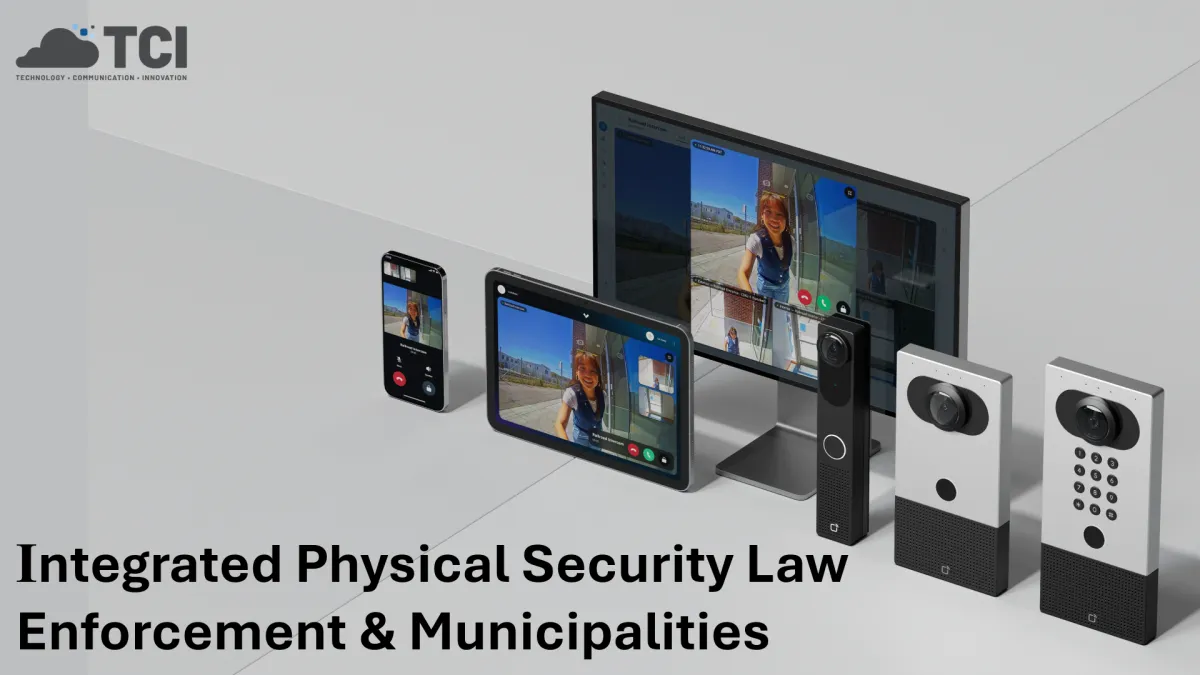
Integrated Physical Security Systems for Law Enforcement & Municipalities | TCI
Beyond Security Cameras: Why Integrated Physical Security Matters for Law Enforcement and Municipalities
A camera can show you what happened.
An access control system can tell you who entered.
An alarm can tell you something was triggered.
A license plate recognition (LPR) system can identify a vehicle.
But what happens when you need to understand how all of those events connect — in real time, during an active investigation, with limited staff and no time to spare?
That's where integrated physical security becomes essential.
For law enforcement agencies and municipalities, security isn't confined to a single building or a single camera feed. Agencies are often responsible for courthouses, administrative buildings, public works facilities, parking areas, parks, utilities, water treatment plants, remote infrastructure, and other public-facing spaces — each with its own risks, layout, and access patterns.
When the technology protecting those locations operates in silos, getting a complete picture of an incident becomes slow, manual, and error-prone.
The future of physical security isn't just about adding more cameras. It's about connecting the information your security systems are already collecting — so your team can act on it faster.
The Problem With Disconnected Security Systems
Picture an after-hours incident at a municipal facility.
A person enters through a restricted door.
The access control system logs the event.
A nearby camera captures the individual.
An alarm is triggered.
A vehicle leaves the property minutes later.
Individually, each system has captured something useful. But if your team has to log into one platform to review access records, another to pull video, and a third to check alarm history, they're stuck manually piecing together a timeline — under pressure, and often after the fact.
That process costs time. And in an active investigation, time is often the difference between resolving an incident quickly and losing the trail entirely.
The real challenge for most agencies isn't a shortage of information. It's too much information scattered across too many platforms, with no easy way to connect it.
Integrated physical security solves this by bringing disparate systems into one connected environment, so information becomes usable — not just collected.
What Is Integrated Physical Security?
Integrated physical security means connecting multiple security technologies so they operate as one coordinated system rather than a collection of standalone tools. Depending on the facility and its risk profile, that can include:
Rather than evaluating each of these as an isolated product, an integrated approach asks a different question: how can these technologies support and inform one another?
TCI designs video surveillance and access control solutions built to work together, giving security and law enforcement teams the ability to manage, monitor, and investigate activity far more efficiently than disconnected systems allow.
From Cameras That Record to Cameras That Investigate
Traditional surveillance cameras serve one core function: recording what happens. That's still valuable — but modern, AI-powered video surveillance can do significantly more.
AI-driven video analytics allow security teams to search footage using natural descriptions — a person in a blue jacket, a red sedan, a specific license plate, or a particular object — instead of scrubbing through hours of raw video frame by frame.
That's a meaningful shift in how investigators work. The question is no longer:
"Which camera recorded this?"
It becomes:
"What are we looking for — and can the system find it for us?"
For agencies with limited staff and dozens (or hundreds) of cameras across multiple properties, that shift can save hours during a single investigation.
AI-Unified Timeline: Connecting the Events
One of the most valuable capabilities in a truly integrated video security environment is the ability to follow events chronologically across multiple cameras and systems — not just within a single feed.
TCI's AI-Unified Timeline compiles activity from multiple cameras into a single chronological view, allowing investigators to trace a person's or vehicle's movement across a property without manually switching between individual video streams.
That becomes even more powerful when non-video events are layered in. For example:
10:42 PM — Access control logs entry through a restricted door
10:43 PM — Camera identifies the individual entering the facility
10:47 PM — Activity appears on a second camera in another zone
10:52 PM — The individual exits through a separate access point
Instead of manually cross-referencing access logs and video timestamps, a unified timeline reconstructs the sequence automatically. For incidents spanning multiple cameras, doors, or buildings, that context can dramatically reduce investigation time.
Connecting Video and Access Control
Video shows you what happened visually. Access control tells you who attempted entry and whether that access was authorized. Together, they provide far more context than either system offers alone.
TCI's access control solutions give administrators detailed access records and audit trails — documenting who accessed which doors, when, and whether any unauthorized attempts occurred. Paired with video, access control can also help identify issues like tailgating, where an unauthorized individual follows an authorized person through a secured entry point.
Consider a simple scenario: an employee's credential badges into a restricted area at 11:30 PM. The access control system logs the credential used. The camera confirms who physically walked through the door. Individually, each system tells part of the story. Together, they tell the whole one.
License Plate Recognition Adds Another Layer
People aren't the only thing that matter in an investigation — vehicles often do too.
License Plate Recognition (LPR) technology automatically captures and catalogs plates as vehicles pass through monitored areas. TCI's video surveillance platform uses LPR to build searchable vehicle records, establish watchlists, and generate real-time alerts for specific plates of interest.
For municipalities and law enforcement, this adds a valuable layer of situational awareness around parking lots, facility entrances, drive lanes, and other vehicle-heavy areas — without requiring additional staff to monitor them manually.
As with video and access control, the value isn't just collecting more data. It's being able to find and use that data the moment it matters.
Why a Centralized Security Platform Matters
The more standalone security tools an agency deploys, the more complex day-to-day management becomes. Without integration, teams often end up juggling:
One system for video
Another for access control
Another for alarms
Another for vehicle/LPR data
Another for visitor management
That's a lot of logins, dashboards, and manual cross-checking for teams that are often already stretched thin.
A centralized platform consolidates these functions into a single operating environment. TCI's video surveillance platform supports pairing AI-powered video with access control and alarm systems, creating what the company describes as a "single pane of glass" for agency-wide security visibility.
For agencies operating with limited personnel, reducing operational complexity can be just as valuable as adding a new security feature — sometimes more so.
Technology Should Extend Your Team, Not Replace It
Law enforcement and municipal personnel already carry demanding workloads. They can't monitor every camera around the clock. They can't be physically present at every facility. They can't manually review every hour of recorded footage.
And with the right tools, they shouldn't have to.
The goal of intelligent physical security isn't to replace personnel — it's to extend their capacity:
AI helps surface relevant information faster
Unified timelines help investigators reconstruct events accurately
Access control provides a reliable audit trail
LPR helps identify and track vehicles of interest
Real-time alerts draw attention to activity that actually matters
Centralized management makes all of the above easier to access and act on
The result is a security environment built around how your team actually operates — not one that forces your team to adapt to disconnected tools.
Building a Security System Around Your Mission
There's no one-size-fits-all security system for every municipality or law enforcement agency.
A courthouse has different security requirements than a public works facility. A sheriff's office has different needs than a remote, unstaffed municipal property. A parking facility may prioritize LPR. A secured government building may prioritize access control. A remote site may be best served by a deployable security trailer or standalone camera system.
Before choosing any specific technology, it's worth answering a few foundational questions:
What are we actually protecting?
Where are the current vulnerabilities?
What does our team need visibility into?
What happens the moment an incident occurs?
How quickly can we access the information we need to respond?
Those answers should shape your security strategy — not the other way around.
TCI: Connecting the Pieces of Physical Security
At TCI, we help businesses, municipalities, and law enforcement agencies design physical security solutions built around their specific environments, risks, and operational realities.
Our capabilities span intelligent video surveillance, access control, alarms and environmental sensors, visitor management, remote and mobile cameras, and other connected security technologies. More importantly, we understand these systems shouldn't operate in isolation. Your cameras, access control, alarms, and other security tools become significantly more valuable when they work together as one system.
The goal isn't simply to give your agency more technology. It's to give your team better visibility, better information, and a faster, more efficient way to manage and investigate security events — before, during, and after they happen.
Ready to Connect Your Security Systems?
If your agency or municipality is managing multiple disconnected security systems — or spending too much time jumping between platforms to investigate incidents — it's worth exploring a more integrated approach.
TCI can evaluate your current physical security environment, identify gaps in visibility and integration, and help design a solution built around your organization's specific needs.
Don't just collect more security data. Make it work together.
👉 Visit tcinow.com to talk with TCI about building a more connected physical security strategy.
Or schedule a security demo with TCI Now!
