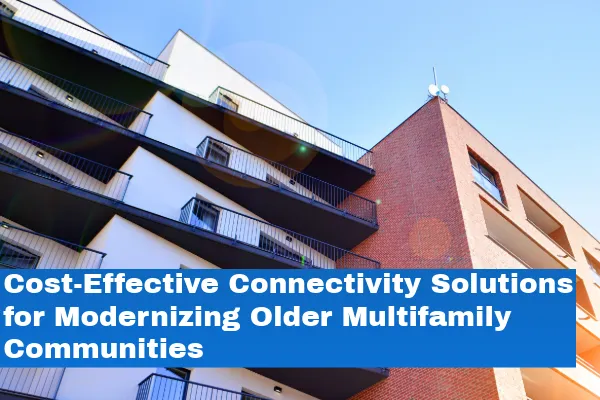
Cost-Effective Connectivity Solutions for Modernizing Older Multifamily Communities
Cost-Effective Connectivity Solutions for Modernizing Older Multifamily Communities
The infrastructure gap in older multifamily housing has never been more apparent or more costly to ignore. Multifamily housing is experiencing a shift in both resident expectations and operational priorities. Today's residents expect modern amenities: reliable Wi-Fi everywhere on the property, smart access control, integrated security, package room technology, and the kind of seamless connectivity they experience in newer luxury developments. At the same time, management companies are under pressure to streamline operations through automation, from meter reading to lighting controls, irrigation management, guest access, self-guided tours, and centralized monitoring. These evolving expectations highlight a growing problem: many existing properties simply were not built with the infrastructure needed to support modern, connected systems. Buildings constructed even 10–15 years ago often lack the conduit, cabling paths, and network distribution required to deploy new technologies at scale. Multi-building properties are even more challenging.As smart building systems and resident-demanded amenities continue to advance, older and historically built communities need solutions that allow them to modernize without undergoing disruptive and cost-prohibitive construction projects.
The challenge for older multi-family housing communities lies in extending network connectivity to remote buildings without incurring prohibitive costs. Line-of-sight wireless technology offers a solution by wirelessly transmitting network signals between buildings, eliminating the need for expensive buried or aerial cables while avoiding recurring monthly fees for multiple internet connections. This approach enables properties to deploy security systems, smart building technologies, and resident amenities across their entire footprint at a fraction of traditional costs.
Property managers have traditionally confronted three options when connecting remote buildings to their network infrastructure: installing buried or aerial cables, purchasing dedicated internet connections for each building, or leaving buildings disconnected entirely. The first option requires professional boring or trenching contractors with substantial upfront costs. The second creates ongoing monthly expenses and operational complexity. The third limits deployment options and fragments management systems. Each approach presents significant drawbacks that impact both capital budgets and operational efficiency.
The cost structure of traditional burial cable installation reveals why many properties struggle with infrastructure expansion. Directional boring companies typically charge setup fees between $1,000 and $2,000 per location, plus $20 to $35 per linear foot for the actual boring work. According to industry standards, fiber installations require even more expensive specialized termination equipment. A five-building complex with 100-foot spacing between structures could face $10,000 in setup costs alone before accounting for materials and fiber termination equipment. Property managers must also budget for lawn repair, landscaping restoration, and potential asphalt patching, which are expenses beyond the installation quote. Additionally, for properties where buildings are separated by public roadways, obtaining right-of-way access can introduce significant delays, permitting requirements, and additional costs. In many cases, securing the necessary right-of-way approvals is as expensive as the construction itself, making cross-roadway networking even more financially prohibitive.
Purchasing a dedicated internet service connection for each remote building presents a different financial burden. Five buildings at $100 monthly generate $6,000 in annual service costs that continue indefinitely and typically increase over time. This approach also fragments network infrastructure, requiring separate firewalls and management systems at each location. Solutions spanning multiple buildings become less integrated, and any internet outage at one location immediately disconnects all devices there. Research from Pacific Northwest National Laboratory demonstrates that infrastructure costs significantly impact deployment decisions, particularly in retrofit scenarios where existing buildings lack adequate connectivity.
Fortunately for property owners and operators, there is a modern, budget-friendly technology gaining a foothold that addresses traditional deployment challenges in a cost-effective manner.Line-of-sight wireless provides direct network connectivity between buildings. Modern systems transmit network signals at high speeds across distances ranging from 100 feet to over 10 miles, depending on the specific application requirements. Installation requires no trenching or boring, and equipment mounts in attics or mechanical closets rather than dedicated ground-level equipment rooms. This technology represents an affordable, one-time capital investment without recurring monthly service fees.
The economic advantages extend throughout the property lifecycle. Installation timelines are typically shorter than burial cable projects, and there is minimal risk of infrastructure damage from future site work. Maintenance requirements are limited, consisting primarily of occasional tree trimming to maintain clear transmission paths. While traditional approaches generate ongoing costs through either monthly service fees or periodic cable repairs, line-of-sight wireless infrastructure requires minimal ongoing investment once deployed.
However, the technology does have limitations that property managers should consider. Line-of-sight wireless requires unobstructed transmission paths between buildings, making it less suitable for properties with dense tree coverage that blocks signal paths. Extreme weather conditions can occasionally affect signal quality, though modern systems incorporate redundancy mechanisms to minimize disruption. Initial equipment costs, while lower than burial alternatives, still represent a capital expenditure that must be planned and budgeted. Properties should conduct thorough site surveys with a knowledgeable vendor, like TCI, to verify that clear line-of-sight paths exist before committing to this approach.
Other benefits of line-of-sight technology are that it supports a broad range of applications across multi-family properties. Security cameras, access control systems, and alarm platforms operate reliably over wireless backhaul connections. Smart thermostats, lighting controls, and other resident-facing technologies become viable across the entire property. Water and power meter reading equipment can operate efficiently without dedicated cabling. Smart irrigation systems, community lighting, and fitness equipment in gyms all benefit from reliable connectivity. Community Wi-Fi and video services extend to any building on the property. Maintenance buildings can house diagnostic equipment that communicates with central management systems. Essentially, any network-dependent technology becomes deployable once remote locations have connectivity.
This versatility positions line-of-sight wireless as an enabling infrastructure for modern property operations. Rather than limiting technology deployments based on connectivity constraints, property managers can evaluate solutions based on resident needs and operational benefits. Remote buildings integrate fully into the community network, enabling centralized management and the smart building capabilities residents increasingly expect.
Line-of-sight wireless technology provides a practical alternative to traditional connectivity methods for older multi-family housing. Properties facing infrastructure expansion decisions should evaluate whether clear line-of-sight paths exist between buildings and compare the total cost of ownership across different approaches. While not suitable for every property configuration, line-of-sight wireless offers significant advantages in scenarios where burial costs are prohibitive and ongoing service fees would accumulate substantially over time. As connectivity demands continue growing across the multi-family sector, technologies that reduce infrastructure costs while maintaining reliability will become increasingly valuable for property owners and managers seeking to balance resident expectations with operational efficiency.
