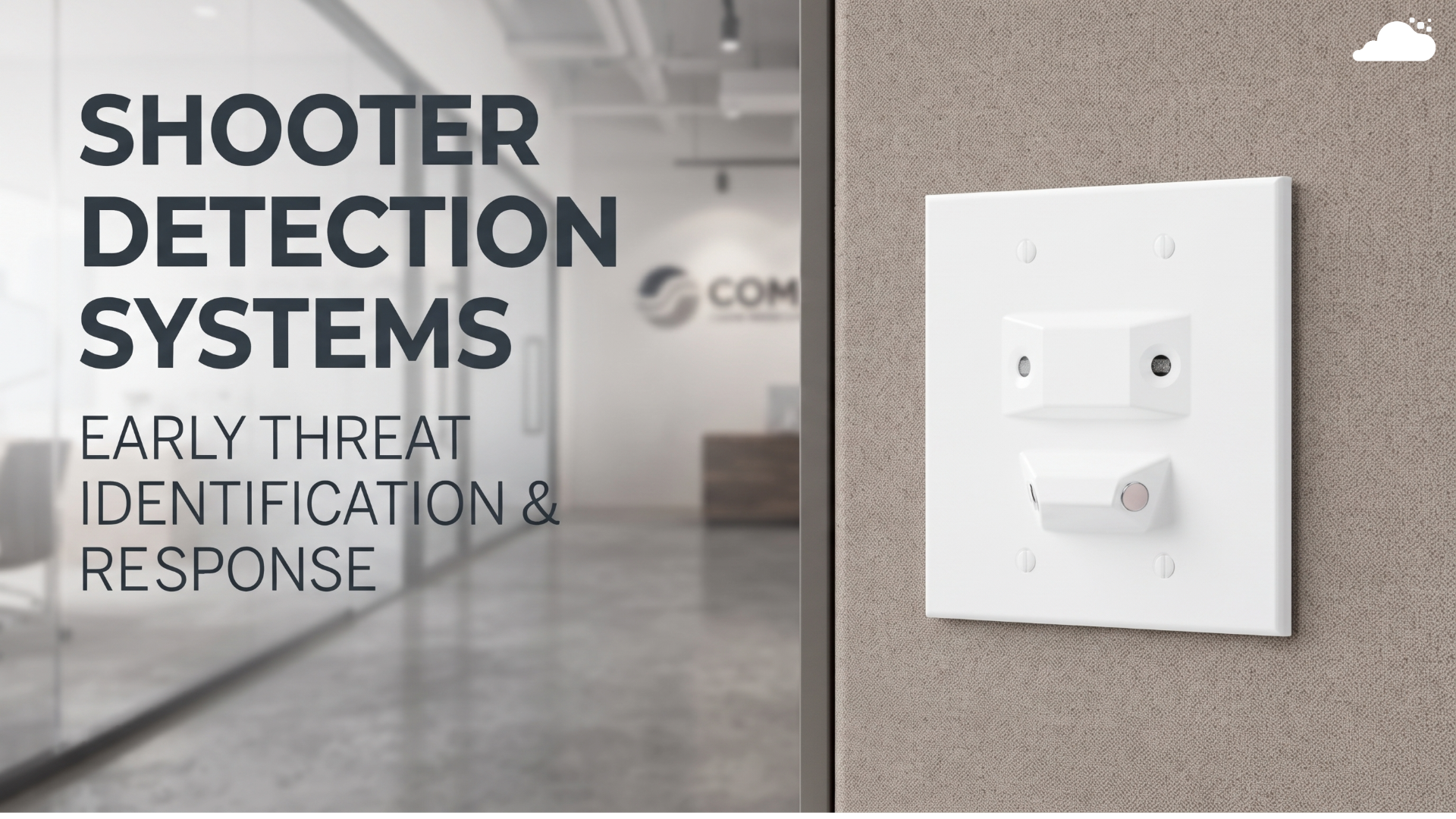
Shooter Detection Systems (SDS): Advanced Gunshot Detection for Businesses
Shooter Detection Systems (SDS): How Gunshot Detection Technology Is Changing Commercial Security
When a gunshot occurs inside a business, school, government building, or public facility, every second matters. The people inside may not immediately recognize what happened, security personnel may not know where the threat is coming from, and emergency responders may not receive accurate information until someone has time to make a call.
Traditional security systems are designed to help organizations monitor activity, control access, and respond to potential threats. But what happens when an emergency unfolds faster than someone can recognize it?
That's where Shooter Detection Systems (SDS) comes in.
SDS, powered by Alarm.com, introduces another layer of protection by using specialized sensors to identify the unique acoustic and infrared signatures of gunfire. Rather than relying entirely on someone witnessing an incident or manually activating an alarm, the technology can automatically recognize a gunshot and communicate critical information to monitoring personnel.
For businesses and organizations throughout Hampton Roads and beyond, this technology offers an opportunity to strengthen existing security infrastructure, improve situational awareness, and help reduce the time between an incident and an emergency response.
At TCI, we believe effective security is about more than installing cameras and locking doors. It's about giving organizations the tools to recognize threats, communicate quickly, and respond with better information when it matters most.
What Is Shooter Detection Systems (SDS)?
Shooter Detection Systems is a gunshot detection technology designed to identify firearm discharges inside buildings and help initiate a coordinated emergency response.
The SDS technology uses specialized sensors and proprietary detection algorithms to recognize the characteristics of an actual gunshot. Once a shot is detected and verified, the system can automatically transmit an alert through the Alarm.com platform to a monitoring station.
Depending on the system configuration, notifications can also be delivered to building occupants and security personnel, while other connected security technologies can be activated to support the emergency response.
The objective is straightforward: reduce the time between a gunshot occurring, the threat being recognized, and the appropriate people receiving the information needed to act.
Unlike traditional surveillance cameras, which generally require someone to observe footage or review an event, gunshot detection technology can identify a potential shooting incident automatically.
This makes SDS particularly valuable for environments where large numbers of people gather, where security teams cannot monitor every area continuously, or where rapid emergency communication is essential.
How Does SDS Gunshot Detection Technology Work?
One of the biggest advantages of SDS is its dual-factor detection technology.
Instead of relying on sound alone, the system combines acoustic and infrared sensing to identify the characteristics of a gunshot. This helps distinguish actual firearm discharges from other loud noises that could otherwise trigger unnecessary alerts.
1. Acoustic Sensors Recognize the Sound of Gunfire
When a firearm is discharged, it produces a distinctive acoustic signature.
SDS sensors use specialized microphones to recognize the sound associated with a gunshot. However, loud noises happen in commercial environments every day. Construction, dropped equipment, slammed doors, and other sudden sounds can create noise that may resemble part of a gunshot's acoustic signature.
This is why sound detection alone isn't enough.
2. Infrared Sensors Identify the Muzzle Flash
Alongside acoustic detection, SDS uses infrared sensors to identify the infrared signature associated with a firearm's muzzle flash.
When the system detects the corresponding acoustic and infrared characteristics, its detection algorithms evaluate the information to determine whether a gunshot has occurred.
This dual-factor approach helps reduce false positives and provides a more reliable method of identifying firearm discharges than relying on audio detection alone.
Alarm.com reports detection accuracy of greater than 99.9% for its SDS solution.
3. Alerts Are Automatically Transmitted
Once a gunshot is confirmed, the system sends an alert through the Alarm.com cloud platform to the designated monitoring station.
According to Alarm.com, the gunshot detection process can deliver alerts in less than one second. The system can also support emergency notifications through local alarms, SMS messages, and push notifications, depending on the configuration.
This means organizations don't have to depend entirely on an employee recognizing the sound, locating a phone, and manually reporting the incident before the security response process begins.
4. Monitoring Personnel Can Help Coordinate Emergency Response
When the monitoring station receives an alert, monitoring personnel can initiate the appropriate emergency response procedures.
The alert provides important information that can help identify the affected location and communicate that a potential shooting incident has occurred.
The goal is to help emergency responders receive critical information as quickly as possible, rather than relying solely on an initial 911 call from someone inside the building.
For organizations with established emergency action plans, this information can also help security teams and employees initiate the appropriate internal protocols.
Why Gunshot Detection Is Different From Traditional Security Cameras
Video surveillance remains one of the most important components of a modern physical security system. Cameras help organizations monitor activity, investigate incidents, identify individuals, and maintain visibility across their properties.
However, cameras and gunshot detection systems serve different purposes.
A camera may capture an incident as it happens, but someone still needs to recognize the event, access the footage, and communicate what is happening. Even with advanced video analytics, organizations shouldn't assume that video surveillance alone will identify every emergency in real time.
Gunshot detection adds another layer of awareness.
Instead of waiting for someone to observe a shooting incident, SDS is designed to automatically recognize the acoustic and infrared characteristics of gunfire.
When integrated into a broader security environment, the technologies can complement one another:
Gunshot detection: Identifies a confirmed gunshot and initiates alerts.
Video surveillance: Provides visual context surrounding the incident.
Access Control: Helps security personnel manage building entry points and restrict access when appropriate.
Intrusion detection: Adds another layer of protection by identifying unauthorized activity.
Emergency notifications: Communicates critical information to employees, occupants, and designated personnel.
The advantage isn't simply having more security equipment. It's having different technologies work together to give security teams a more complete picture of what's happening.
Key Benefits of Shooter Detection Systems for Businesses and Organizations
Gun violence is a concern for organizations across a wide range of industries. While no technology can guarantee that an incident will never happen, having the ability to identify a threat and communicate information quickly can make an important difference.
Here are several reasons organizations are incorporating gunshot detection into their physical security strategies.
Faster Identification of Potential Shooting Incidents
One of the biggest challenges during an active shooter situation is recognizing what is happening.
People may mistake gunfire for fireworks, construction, dropped objects, or other loud noises. In some environments, employees may not immediately realize that an emergency is taking place.
SDS is designed to recognize gunshots automatically, helping reduce reliance on human observation and manual reporting.
Fewer False Alarms Through Dual-Factor Detection
Unnecessary security alerts can create confusion and slow down response efforts.
Because SDS combines acoustic and infrared sensing, it can evaluate multiple characteristics associated with a gunshot before generating an alert.
This is particularly important in environments with frequent background noise, such as manufacturing facilities, warehouses, transportation centers, and other commercial properties.
Improved Emergency Communication
During an emergency, communication is often just as important as detection.
SDS can automatically notify monitoring personnel and support notifications to building occupants through configured communication channels.
This helps organizations communicate important information without relying exclusively on someone manually initiating every step.
Better Situational Awareness for First Responders
Knowing that an incident has occurred is important. Knowing where it happened is equally important.
Gunshot detection technology can provide location information that helps security personnel and emergency responders better understand the situation.
When paired with video surveillance and other connected security technologies, organizations can build a more informed picture of an incident.
Integration With Existing Security Infrastructure
Organizations don't necessarily need to think about gunshot detection as a standalone solution.
SDS Powered by Alarm.com is designed to work within the Alarm.com for Business platform, complementing connected security technologies such as video surveillance, intrusion detection, and access control.
Depending on the deployment and system configuration, a confirmed event can initiate additional security actions, including video recording, access control responses, and occupant notifications.
This creates an opportunity to move beyond disconnected security devices and toward a more coordinated security environment.
Where Can Gunshot Detection Systems Be Used?
Gunshot detection isn't limited to schools or government buildings. Any facility with employees, customers, visitors, or members of the public can benefit from evaluating whether this technology belongs in its security strategy.
Some common applications include:
Schools and Educational Facilities
Schools need security strategies that account for students, faculty, staff, visitors, and multiple building entrances.
Gunshot detection can add another layer of awareness by helping identify a shooting incident and initiate emergency notifications.
When combined with access control, video surveillance, and established emergency action plans, the technology can support a more coordinated approach to campus security.
Government Buildings and Municipal Facilities
Government buildings frequently serve large numbers of employees and visitors.
Courthouses, municipal offices, public safety facilities, and other government properties can benefit from technology that helps identify emergencies and communicate information quickly.
For municipalities managing multiple facilities, integrating gunshot detection into a broader security strategy can help create more consistent emergency response procedures.
Healthcare Facilities
Hospitals and healthcare facilities present unique security challenges. They operate around the clock, serve vulnerable populations, and often have multiple public entrances and restricted-access areas.
Gunshot detection can provide an additional layer of awareness in emergency departments, waiting areas, administrative buildings, and other designated spaces.
Retail Stores and Commercial Properties
Retail businesses, gas stations, financial institutions, and other customer-facing facilities may experience security risks that require more than traditional cameras and alarms.
Gunshot detection can help these organizations identify a shooting incident and initiate an emergency notification process without waiting for an employee or customer to report what happened.
Warehouses and Manufacturing Facilities
Large industrial properties can be particularly challenging to monitor.
Noise from machinery, equipment, and daily operations can make it difficult to recognize unusual sounds. SDS uses both acoustic and infrared detection to help distinguish gunfire from other environmental noises.
For facilities with large footprints, strategically designed sensor coverage can add another layer of protection.
Churches, Entertainment Venues, and Public Gathering Spaces
Places of worship, theaters, event venues, and recreational facilities regularly bring large groups of people together.
Gunshot detection can support these organizations by helping identify potential shooting incidents and communicate alerts to designated personnel.
The technology can be especially valuable when paired with a comprehensive emergency action plan.
Understanding SDS Sensor Coverage and Installation
An important part of implementing any gunshot detection system is understanding how the sensors are designed to operate.
The SDS indoor gunshot sensor is a compact device designed for wall or ceiling installation. Its discreet footprint allows it to blend into many commercial environments without requiring large or intrusive equipment.
According to Alarm.com, each indoor sensor provides:
Up to 2,500 square feet of coverage.
180-degree field of view.
Detection without requiring direct line of sight to the firearm.
Acoustic and infrared dual-factor detection.
Power over Ethernet (PoE) connectivity.
Integration with the Alarm.com cloud platform.
The ability to detect gunshots without direct line of sight is particularly important. Traditional cameras depend on having a visual field of view, but gunshot detection sensors are designed to recognize the acoustic and infrared signatures of gunfire without needing to see the firearm itself.
This allows organizations to evaluate coverage based on the layout of their facility rather than relying exclusively on camera positioning.
Proper placement still matters. Building layout, walls, ceilings, environmental conditions, network infrastructure, and the areas an organization wants to protect should all be considered when planning deployment.
A professional security assessment can help determine how many sensors are appropriate and where they should be installed.
Why Gunshot Detection Should Be Part of a Larger Security Strategy
Installing a gunshot detection system is an important step, but it shouldn't be the only step an organization takes to prepare for an emergency.
Technology works best when it supports an established security strategy.
For example, consider a facility that has video surveillance, controlled entry points, and gunshot detection installed.
If a gunshot occurs, SDS can identify the event and transmit an alert. Monitoring personnel can receive the notification, while connected video systems can help provide additional visual context. Depending on the configuration, access control and notification systems may also support the organization's emergency response procedures.
Rather than relying on separate devices and disconnected communication channels, organizations can work toward a coordinated security environment.
This is where working with an experienced security integration partner becomes important.
A professional assessment should consider:
Which areas of the facility need gunshot detection coverage.
How existing cameras can support incident verification.
Whether access control can support emergency lockdown procedures.
How employees and occupants will receive emergency notifications.
Whether network connectivity and backup communication are adequate.
How monitoring personnel and emergency responders will receive relevant information.
How the system fits into the organization's existing emergency action plan.
The objective is to create a system that supports people during an emergency, not simply add another piece of equipment to the building.
Strengthen Your Facility's Security With TCI
At TCI, we help businesses, municipalities, schools, healthcare facilities, and other organizations throughout Virginia and North Carolina develop physical security solutions that address real-world risks.
From video surveillance and access control to intrusion detection and advanced security technologies, our team works with organizations to design systems that improve visibility, strengthen protection, and support faster response.
Shooter Detection Systems (SDS) powered by Alarm.com offers another opportunity to strengthen that approach.
By adding automated gunshot detection to a connected security environment, organizations can improve their ability to recognize a potential shooting incident, communicate critical information, and coordinate an appropriate response.
Whether you're evaluating gunshot detection for a single building or considering a broader security upgrade across multiple facilities, TCI can help you explore the right solution for your environment.
Don't wait until an emergency to evaluate your security strategy.
Contact TCI to discuss how gunshot detection, video surveillance, access control, and integrated security technologies can help protect your people and property.
